
Germany Visa Guide for Zimbabweans 2026: Visa Types, Fees, Requirements and Application Steps
Germany is one of Europe’s strongest destinations for study, work, vocational training, family reunion, language learning, tourism, and skilled migration. But the German visa process is strict. The embassy fee is usually not the real challenge. The real challenge is choosing the correct visa category, preparing the right documents, proving sufficient funds, and submitting a complete application.
Quick Answer: Zimbabwean applicants usually apply for either a Schengen visa for short stays of up to 90 days, or a national visa for long-stay purposes such as study, work, Ausbildung, family reunion, au pair, voluntary service, language courses, or job search routes. The correct visa depends on your purpose, documents, finances, and long-term plan.
Important: Germany visa rules, fees, blocked account amounts, appointment systems, and document requirements can change. Always verify the latest instructions with the German Embassy in Harare and official German sources before applying.
What This Germany Visa Guide Covers
1. Quick Germany Visa Facts 2. Which Germany Visa Do You Need? 3. Tourist / Visitor Visa 4. Family Reunion Visa 5. Language Course Visa 6. Germany Study Visa 7. Au Pair Visa 8. Ausbildung Visa 9. General Employment Visa 10. Skilled Worker Visa 11. Voluntary Service Visa 12. Opportunity Card / Job Search Route 13. Germany Visa Application Steps 14. Core Document Checklist 15. The Real Cost of Germany Applications 16. Why Germany Visa Applications Fail 17. How Varsity Visa Can Help 18. Frequently Asked Questions1. Quick Germany Visa Facts
| Item | Common Figure / Guidance | Important Note |
|---|---|---|
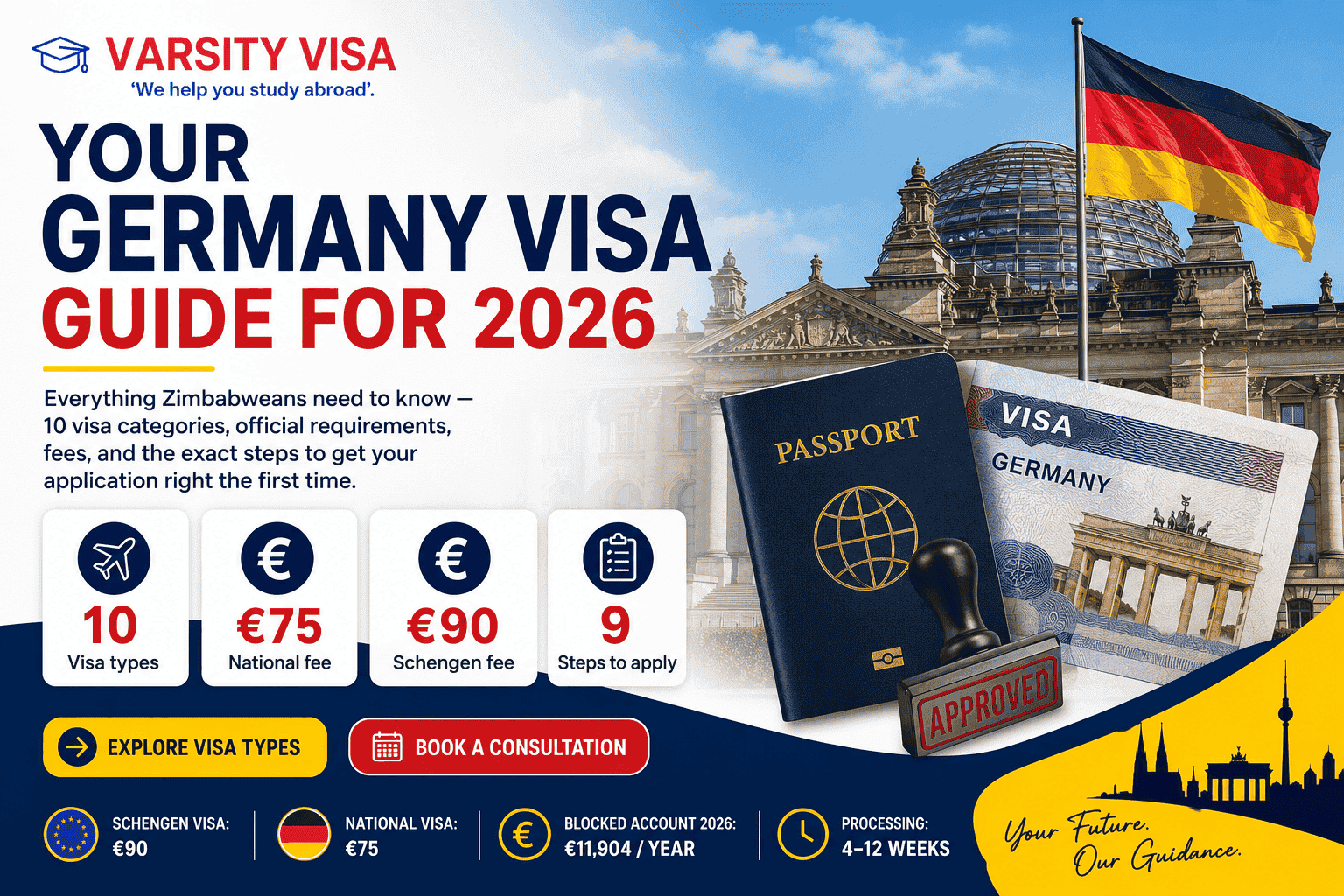
| Schengen visa fee | Usually €90 | For short stays up to 90 days. |
| National visa fee | Usually €75 | For long-stay routes such as study, work, family reunion, Ausbildung, and related routes. |
| Blocked account benchmark | Often referenced as an annual amount for student and some long-stay routes | Always verify the current amount before applying because it can change. |
| Schengen processing | Often faster than national visas | Apply early, especially during peak travel periods. |
| National visa processing | Can take several weeks or months | Depends on route, documents, and whether German authorities must be involved. |
Do not build your plan around embassy fees only.
The real cost is usually financial proof, blocked account, flights, accommodation, insurance, translations, legalisation, and settlement costs.
2. Which Germany Visa Do You Need?
Your visa category must match your real purpose of travel.
Choosing the wrong visa type can lead to delays, refusal, or being told to restart the process.
Below are the main Germany visa routes Zimbabwean applicants commonly ask about.
- Tourist / Visitor Visa
- Family Reunion Visa
- Language Course Visa
- Study Visa
- Au Pair Visa
- Vocational Training / Ausbildung Visa
- General Employment Visa
- Skilled Worker Visa
- Voluntary Service Visa — FSJ / BFD
- Job Search / Opportunity Card Route
3. Tourist / Visitor Visa
Visa type: Schengen Visa · Type C
Duration: Up to 90 days within a 180-day period
Typical fee: €90
Work rights: Not permitted
Best for: Tourism, visiting family or friends, attending short events, or short business visits
Requirements May Include
- Valid passport
- Completed visa application form
- Two biometric passport photos
- Invitation letter, hotel booking, or host details
- Return or onward travel reservation
- Travel insurance with minimum medical cover required for Schengen travel
- Proof of sufficient funds
- Proof of accommodation in Germany
- Proof of ties to Zimbabwe, such as employment, studies, business, family, or assets
- Cover letter explaining the purpose of travel
Consultant’s Guidance: A Schengen visa is not a work visa. It is also not a study visa. If your real intention is to work, stay long term, join family permanently, study, or search for employment, do not apply under tourism simply because it looks easier.
4. Family Reunion Visa
Visa type: National Visa · Type D
Best for: Joining a spouse, parent, child, or eligible family member in Germany
Typical fee: €75
Duration: Long stay, followed by residence permit in Germany
Requirements May Include
- Valid passport
- Completed national visa application form
- Proof of family relationship
- Marriage certificate, birth certificate, or other civil documents
- Certified translations where required
- Apostille or legalisation where required
- Passport or residence permit of the family member in Germany
- Proof of accommodation in Germany
- Proof of income or financial support
- German language certificate where required
- Health insurance
- Cover letter
Family reunion is document-heavy. The relationship must be proven clearly. Civil documents must match names, dates, and spellings. Small inconsistencies can cause delays.
5. Language Course Visa
Visa type: National Visa · Type D
Best for: Intensive German language study in Germany
Typical fee: €75
Duration: Usually linked to the course duration
Requirements May Include
- Valid passport
- Completed national visa application form
- Admission letter from a recognised language school
- Proof of payment or enrolment
- Proof of sufficient funds
- Accommodation proof
- Health insurance
- Motivation letter
- Education and employment history
- Proof that the course is intensive and suitable for visa purposes
A language course visa must be credible. The embassy will want to understand why you need to study German in Germany and how the course fits your future plan.
6. Germany Study Visa
Visa type: National Visa · Type D
Best for: University study, preparatory programmes, and recognised study pathways
Typical fee: €75
Financial proof: Blocked account, scholarship, sponsor proof, or another accepted form of financial evidence
Requirements May Include
- Valid passport
- Completed national visa application form
- University admission letter
- Proof of financial means
- Blocked account confirmation, scholarship letter, or acceptable sponsor proof
- Academic certificates and transcripts
- Proof of language proficiency, where required
- Motivation letter
- CV
- Health insurance
- Accommodation proof
- Previous study or employment history
- Certified translations where required
Germany is attractive because many public universities have low tuition fees. But low tuition does not mean cheap migration. The blocked account, accommodation, flights, insurance, semester contribution, documents, and settling-in costs must be planned properly.
Before choosing Germany because tuition looks affordable, read our guide on the hidden cost of studying abroad .
7. Au Pair Visa
Visa type: National Visa · Type D
Best for: Young people joining a German host family for cultural exchange and childcare support
Typical fee: €75
Duration: Usually up to 12 months
Requirements May Include
- Valid passport
- Completed national visa application form
- Au pair contract
- Host family documents
- Proof of basic German language ability
- Motivation letter
- Health insurance
- Accommodation and support details
- Age eligibility evidence
- Education background documents
Au pair is not simply “going to work in Germany.” It is a cultural exchange route with specific conditions.
8. Vocational Training Visa — Ausbildung
Visa type: National Visa · Type D
Best for: Apprenticeship or vocational training in Germany
Typical fee: €75
Best suited for: Applicants with the right qualifications, German language ability, and a confirmed training contract
Requirements May Include
- Valid passport
- Completed national visa application form
- Signed vocational training contract
- Proof of German language ability
- School certificates and transcripts
- CV
- Motivation letter
- Proof of accommodation
- Health insurance
- Proof of financial means, if training salary is insufficient
- Recognition or equivalence documents where required
Consultant’s Guidance: Ausbildung is one of the strongest Germany pathways for Zimbabweans, but it is not easy. German language is usually the biggest barrier. A training contract is also essential.
9. General Employment Visa
Visa type: National Visa · Type D
Best for: Applicants with a confirmed employment offer in Germany
Typical fee: €75
Duration: Long stay, followed by residence permit
Requirements May Include
- Valid passport
- Completed national visa application form
- Employment contract or binding job offer
- Employer details
- CV
- Qualifications and employment references
- Proof of professional experience
- Recognition of qualifications where required
- Health insurance
- Accommodation or relocation plan
- Cover letter
A job offer is not always enough. Germany may need to assess whether your qualification, salary, role, employer, and background fit the visa route.
10. Skilled Worker Visa
Visa type: National Visa · Type D
Best for: Qualified professionals with recognised qualifications and a suitable German job offer
Typical fee: €75
Key issue: Recognition of qualification or professional equivalence
Requirements May Include
- Valid passport
- Completed national visa application form
- Job contract
- Recognised qualification or equivalence assessment
- Professional licence where required
- CV
- Work references
- Proof of salary and job conditions
- Health insurance
- Accommodation plan
- German language proof where required
Recognition is the key issue. For professions such as nursing, medicine, engineering, teaching, and other regulated sectors, the qualification must be assessed carefully. Do not assume that a Zimbabwean qualification automatically qualifies you for skilled work in Germany.
For more on recognition risk in regulated professions, read our article on professional recognition and medical study abroad planning .
11. Voluntary Service Visa — FSJ / BFD
Visa type: National Visa · Type D
Best for: Voluntary social service, youth service, and community-based programmes
Typical fee: €75
Duration: Linked to the voluntary service contract
Requirements May Include
- Valid passport
- Completed national visa application form
- FSJ/BFD contract
- Host organisation documents
- Proof of accommodation
- Health insurance
- Motivation letter
- CV
- Education documents
- German language proof where required
FSJ and BFD can be useful routes for young applicants seeking experience in Germany. But they must be genuine voluntary service routes.
12. Job Search / Opportunity Card
Visa type: National Visa · Points-based / job-search route
Best for: Qualified applicants who want to enter Germany to search for suitable employment
Typical fee: €75
Key issue: Points, qualification, work experience, language ability, and financial proof
Requirements May Include
- Valid passport
- Completed national visa application form
- Proof of qualification
- Proof of recognition or comparability where required
- CV
- Work experience documents
- Language proof, where required
- Proof of sufficient funds
- Health insurance
- Accommodation plan
- Job-search strategy or motivation letter
The Opportunity Card can be attractive, but it is not a shortcut. You must show that you are employable, financially prepared, and realistic about your job search.
13. Germany Visa Application Steps from Zimbabwe
Follow these steps before applying from Zimbabwe. Missing one step can lead to delays, requests for more documents, or refusal.
Step 1: Identify the Correct Visa Category
Start with your real purpose. Are you visiting, studying, joining family, learning German, training, volunteering, working, or searching for a job? Do not choose the route that looks easiest. Choose the route that matches your actual intention.
Step 2: Secure Your Anchor Document
Most Germany visa applications need a core document that proves your purpose.
- University admission letter
- Job contract
- Training contract
- Host family agreement
- Invitation letter
- Family relationship document
- FSJ/BFD contract
- Language school enrolment
Step 3: Prove Financial Capacity
Financial proof is one of the biggest barriers for Zimbabwean applicants. For long-stay routes, Germany may require a blocked account, scholarship confirmation, sponsor proof, employer salary, or another accepted form of financial evidence.
Step 4: Prepare Insurance
Schengen applicants normally need travel insurance with suitable medical cover valid across the Schengen area. National visa applicants may need health insurance covering the initial stay until they are properly insured in Germany.
Step 5: Translate, Certify, and Legalise Documents Where Required
Some documents may need certified translation, notarisation, apostille, or legalisation. This is especially common for civil documents, academic certificates, professional qualifications, family reunion documents, and recognition applications.
Step 6: Book Your Embassy Appointment
Germany visa appointments for Zimbabwean applicants are handled through official German systems. Do not rely on brokers. Do not pay anyone who claims they can guarantee an appointment.
Step 7: Attend the Visa Interview
Carry complete documents. Prepare originals and copies where required. Be ready to explain your purpose, finances, background, and plans. Answer honestly. Do not memorise fake answers.
Step 8: Wait for the Decision
Schengen applications may be processed faster than national visa applications. National visas can take several weeks or months depending on the route, documentation, and whether German authorities must be involved.
Step 9: Arrive in Germany and Complete Local Registration
For long-stay routes, receiving the visa is not the end of the process. After arrival, you may need to register your address, apply for or convert to a residence permit, activate health insurance, and follow local immigration deadlines.
14. Core Document Checklist
Every Germany visa category has its own checklist. However, most applications begin with the following documents.
Identity and Passport
- Valid passport
- Passport issued within the last 10 years
- Passport valid beyond the intended stay
- At least two blank pages
- Previous passports, where relevant
- Recent biometric passport photos
Forms and Fees
- Completed visa application form
- Visa fee
- Signed declarations where required
- Appointment confirmation
- Cover letter explaining the purpose of travel
Financial Proof
- Bank statements
- Blocked account confirmation, where required
- Scholarship letter, where applicable
- Sponsor documents, where accepted
- Employment income proof
- Proof of accommodation and living cost planning
Insurance
- Travel insurance for Schengen visa
- Health insurance for national visa routes
- Insurance valid for the correct period and territory
Purpose-Specific Documents
- University admission letter
- Employment contract
- Vocational training contract
- Host family agreement
- Family reunion documents
- Invitation letter
- Language school enrolment
- FSJ/BFD contract
- Job-search or Opportunity Card documents
Qualifications
- Academic transcripts
- School certificates
- Degree certificates
- Vocational certificates
- Professional licences
- Recognition or equivalence documents, where required
- CV in English or German
Translations and Legalisation
- Certified translations where required
- Apostille or legalisation where required
- Notarised copies where originals cannot be submitted
- Correct spelling and date consistency across documents
15. The Real Cost of Germany Applications
Germany visa fees are affordable.
The real work is the preparation.
The official visa fee is usually far smaller than the full cost of the pathway.
The real cost may include:
- Blocked account funds
- Accommodation deposits
- Flights
- Insurance
- Translation
- Notarisation
- Apostille or legalisation
- University fees
- Semester contribution
- Language classes
- Courier costs
- Relocation expenses
- Emergency reserve
The wrong question is: How much is the visa fee?
The better question is: Can I afford the full route from application to arrival and settlement?
16. Why Germany Visa Applications Fail
Germany visa applications can fail for several reasons, including:
- Wrong visa category
- Incomplete documents
- Weak financial proof
- Unclear purpose of travel
- Suspicious or inconsistent information
- Poorly prepared interview answers
- Missing translations or legalisation
- Weak ties to Zimbabwe for short-stay visas
- Lack of qualification recognition for work routes
- Applying too late
For a broader explanation of refusal patterns, read our guide on why student visas get rejected and how Zimbabwean applicants can avoid them .
17. Need Help Choosing the Right Germany Visa Route?
Varsity Visa Consultants helps Zimbabwean applicants understand Germany visa options, requirements, documents, and preparation steps.
We can help you assess:
- Which Germany visa category fits your purpose
- Whether your documents are ready
- Whether your financial proof is strong enough
- Whether your study, work, training, or family route makes sense
- What risks must be addressed before applying
Our role is not to promise approval.
Our role is to help you prepare properly before you walk into the embassy.
Book a Germany Visa Consultation
Before choosing a Germany route, get an honest review of your purpose, documents, financial proof, and visa readiness.
Send GERMANY VISA on WhatsApp.
WhatsApp +263 775 050 99018. Frequently Asked Questions
What is the difference between a Schengen visa and a national visa?
A Schengen visa is generally for short stays of up to 90 days within a 180-day period. A national visa is usually for long-stay purposes such as study, work, family reunion, vocational training, language courses, au pair, voluntary service, and similar routes.
Can I work in Germany on a tourist visa?
No. A tourist or visitor visa is not a work visa. If your purpose is employment, training, job search, or long-term stay, you must apply under the correct route.
Is Germany cheap for Zimbabwean students?
Germany may have low tuition at many public universities, but the total cost can still be high because of blocked account requirements, flights, accommodation, insurance, semester contributions, translations, and settling-in costs.
Do I need German language for Germany?
It depends on the route. Ausbildung, au pair, many jobs, regulated professions, and some family reunion cases may require German. Some university programmes may be taught in English, but daily life and work opportunities often still benefit from German language ability.
Can Varsity Visa guarantee a Germany visa?
No. No consultant can guarantee a visa. Visa decisions are made by the relevant German authorities. Varsity Visa helps applicants prepare properly, identify risks, and submit stronger applications.
Prepare Your Germany Visa Route Properly
Germany rewards preparation. Do not guess your route, documents, finances, or timeline.
Send GERMANY VISA on WhatsApp.
WhatsApp +263 775 050 990