
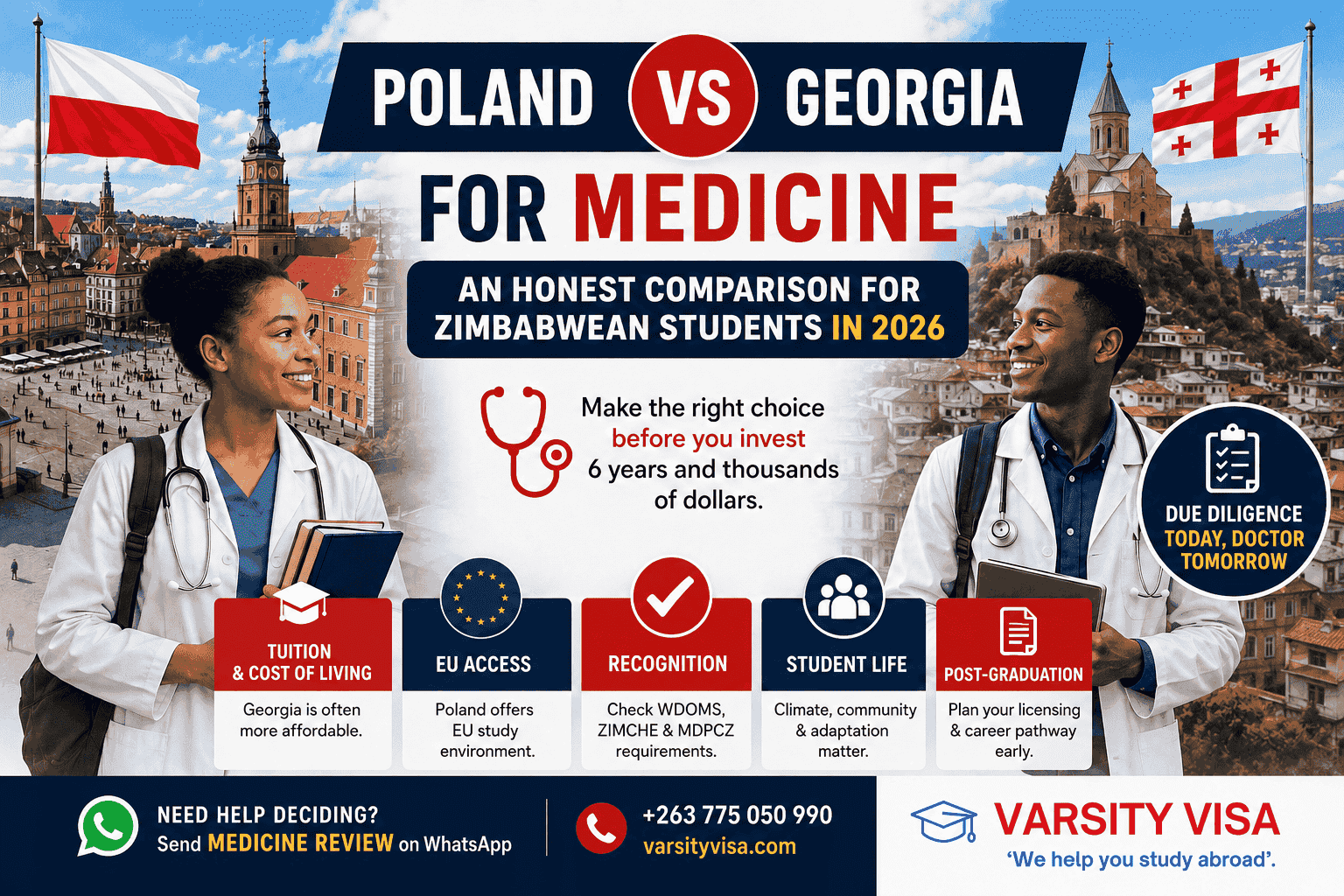
Poland vs Georgia for Medicine: An Honest Comparison for Zimbabwean Students in 2026
Poland and Georgia are two of the most discussed destinations for Zimbabwean students who want to study medicine abroad. Both can be more affordable than traditional destinations such as the UK, USA, Canada, or Australia. Both have universities that offer medical programmes in English. But they are not the same.
Choosing between Poland and Georgia based only on tuition fees is one of the most expensive mistakes a family can make.
Medicine is not a one-year experiment.
It is usually a six-year academic, financial, emotional, and professional commitment.
Before a family chooses Poland or Georgia, they must understand the full picture: cost, recognition, visa pathway, post-graduation options, student life, climate, language, professional registration, and the student’s long-term plan.
Quick Answer: Poland may suit students who want an EU study environment, can manage higher costs, and have a post-graduation plan connected to Europe. Georgia may suit students who need lower tuition and have carefully verified the university, medical programme, WDOMS listing, ZIMCHE assessment pathway, and MDPCZ registration implications. The right choice depends on the student’s budget, academic profile, target country of practice, and long-term career plan.
Important: For regulated professions such as medicine, law, engineering, nursing, pharmacy, architecture, and accounting, admission abroad is not enough. Families must verify whether the qualification can support professional recognition or registration in the country where the graduate wants to work.
Free Download: Medicine Abroad Due Diligence Checklist
Before paying tuition or accepting a medical offer abroad, use our checklist to review the university, programme recognition, WDOMS listing, ZIMCHE considerations, MDPCZ registration issues, visa risks, clinical training, and six-year budget.
This checklist is designed for Zimbabwean parents comparing medicine options in Poland, Georgia, and other destinations.
Download the Free ChecklistOr send MEDICINE CHECKLIST on WhatsApp.
WhatsApp +263 775 050 990What This Guide Covers
1. Why the Poland vs Georgia Question Matters 2. Poland vs Georgia at a Glance 3. Why Regulated Professions Need Extra Due Diligence 4. Cost: Georgia Is Cheaper on Paper 5. Hidden Cost of Changing Countries Later 6. Degree Recognition After Graduation 7. How Parents Can Verify a Foreign Medical Degree 8. ZIMCHE, MDPCZ, and Zimbabwe Recognition 9. Post-Graduation Options 10. Student Life, Climate, and Adaptation 11. Visa Process 12. IELTS and English Requirements 13. Academic Pressure in Medicine 14. Questions Families Should Ask 15. So Which Is Better? 16. How Varsity Visa Can Help 17. Frequently Asked Questions1. Why the Poland vs Georgia Question Matters So Much
Medicine is one of the most serious study abroad decisions a family can make.
The total investment can easily move into tens of thousands of dollars over six years once tuition, accommodation, living expenses, insurance, flights, document processing, visa costs, and emergency reserves are included.
At that level, choosing the wrong country is not a small inconvenience.
It can become a costly mistake.
Many families begin the comparison too casually.
- “Poland is better because it is in Europe.”
- “Georgia is better because it is cheaper.”
- “My cousin’s child went to Poland.”
- “Someone on Facebook said Georgia is easier.”
- “The university agent said the degree is recognised everywhere.”
That is not enough.
The real question is not simply: Which country is cheaper?
The better question is: Which country makes sense for this student’s budget, academic profile, career goal, licensing pathway, and ability to adapt?
2. At a Glance: Poland vs Georgia for Medicine
The table below gives a starting point. It should not be treated as final advice because costs, visa rules, recognition pathways, and university requirements can change.
| Factor | Poland | Georgia |
|---|---|---|
| Tuition | Often higher | Often lower |
| Typical tuition range | Commonly around $7,000–$10,000 per year | Commonly around $5,000–$8,000 per year |
| Programme duration | Usually 6 years for medicine | Usually 6 years for medicine |
| EU membership | Yes | No |
| Language of instruction | English programmes available | English programmes available |
| Climate | Cold winters | Milder winters than Poland |
| African student community | Larger and more established in some cities | Smaller but growing |
| Visa process | Polish national visa and residence process | Georgian student visa/residence process |
| Recognition risk | Still requires checking by target country of practice | Still requires checking by target country of practice |
| Best suited for | Students with stronger budgets and Europe-linked goals | Students with tighter budgets and a carefully verified recognition plan |
3. Why Regulated Professions Need Extra Due Diligence
Medicine is not like every other degree.
A student who studies business, marketing, international relations, or computer science may have more flexibility when moving between countries and job markets.
But some professions are regulated.
- Medicine
- Law
- Engineering
- Nursing
- Pharmacy
- Dentistry
- Architecture
- Accounting and auditing
- Teaching in some jurisdictions
In regulated professions, getting the degree is not the same as being allowed to practise.
The graduate may still need professional registration, board exams, internship, supervised practice, local licensing, language tests, degree verification, or further assessment.
The mistake is assuming that admission equals career approval. Admission allows the student to begin the degree. Professional recognition determines what the graduate can do with that degree later.
This same principle also applies to law and engineering. A law degree from one country may not automatically allow someone to practise law in Zimbabwe. An engineering degree may still need assessment by the relevant professional body. For now, this article focuses on medicine, but the principle is the same: regulated professions require serious verification before payment.
4. Cost: Georgia Is Cheaper on Paper, but the Gap Must Be Calculated Properly
Georgia often looks more attractive at first because tuition fees can be lower.
For a six-year medical degree, even a $2,000 difference per year becomes serious money.
That could mean a saving of $12,000 over the full programme.
For many Zimbabwean families, that is not a small difference.
But families must not compare tuition alone.
A proper six-year budget should include:
- Tuition
- Accommodation
- Food
- Transport
- Health insurance
- Visa or residence permit costs
- Flights
- Winter clothing
- Books and study materials
- Medical equipment where required
- Document processing
- Emergency reserves
- Currency transfer costs
- Possible tuition increases
- Resit or repeat costs
If you are still thinking only in terms of tuition, read our guide on the hidden cost of studying abroad for Zimbabwean families .
The real question is not: Which country has cheaper tuition?
The better question is: Which option can this family sustain for the full six years without financial collapse?
5. The Hidden Cost Families Rarely Calculate: Changing Countries Later
One of the most expensive mistakes is choosing a country quickly, then trying to transfer after year one or year two.
Transfers can be complicated. Credits may not be accepted. The student may lose time. The family may lose tuition already paid. Visa preparation may restart. Emotionally, the student may also struggle because they have to adjust all over again.
The cheapest first option is not always the cheapest final outcome.
6. Degree Recognition: The Question That Matters After Graduation
This is one of the most important areas in the Poland vs Georgia comparison.
A medical degree is not useful simply because the university says it is international. The degree must support the student’s future licensing pathway.
- Is the university recognised by the relevant authorities in that country?
- Is the medical school listed in the World Directory of Medical Schools where relevant?
- Will the degree be accepted by the licensing body in the country where the student wants to practise?
- What exams will the graduate need to write after graduation?
- What internship, residency, or supervised practice requirements apply?
- Does the student intend to practise in Zimbabwe, the UK, the EU, South Africa, Australia, Canada, or somewhere else?
- Does the chosen country create a clear pathway to that goal?
The most important question is: Where does the student want to practise medicine after graduation?
7. How Parents Can Verify a Foreign Medical Degree Before Paying Tuition
For Zimbabwean families considering medicine in Poland, Georgia, or any other country, admission is only the first step.
A university may accept the student. The programme may be approved in that country. The offer letter may look official. The degree may even appear in international databases. But that still does not automatically answer the most important question:
Will this qualification help the student practise medicine where they want to practise after graduation?
For medicine, families must separate four different issues:
| Issue | What It Means | Why It Matters |
|---|---|---|
| University admission | The university has accepted the student. | This only allows the student to begin the process. |
| Local programme recognition | The programme is approved in the country where the university operates. | A programme should first be legitimate in its own country. |
| Academic qualification assessment | The degree can be evaluated for use in another country, such as Zimbabwe. | This may affect employment, further study, or official recognition. |
| Professional registration | The graduate can meet the requirements to practise as a doctor. | This determines whether the graduate can actually work as a doctor. |
Step 1: Confirm That the University Is Recognised in Its Own Country
The first question is whether the university and programme are legally recognised by the relevant education authority in the country where the university operates.
Do not rely only on the agent’s word, posters, or WhatsApp screenshots. Ask for official confirmation or check directly with the relevant national authority where possible.
Step 2: Check Whether the Medical School Appears in the World Directory of Medical Schools
For medicine, one important verification step is checking whether the medical school appears in the World Directory of Medical Schools.
This does not automatically guarantee that the graduate can practise in Zimbabwe, the UK, the EU, Canada, Australia, or anywhere else. But it is still an important starting point.
- Is the exact medical school listed?
- Is the exact campus listed?
- Is the programme listed correctly?
- Is the qualification title correct?
- Are there any notes or restrictions?
- Does the listing align with the university’s claims?
The keyword is exact. Do not check only the university name. Check the medical school, programme, campus, and qualification carefully.
Step 3: Ask the University for Written Clarification
Before paying major fees, parents should ask the university clear written questions.
- Is the Medical Doctor programme officially recognised in your country?
- Which national authority recognises or accredits the programme?
- Is the medical school listed in the World Directory of Medical Schools?
- Are there graduates from your programme practising in Zimbabwe?
- Have your graduates registered with MDPCZ before?
- Can you provide a list of countries where graduates have successfully registered?
- Are clinical rotations included in the six-year programme?
- Where are the clinical rotations done?
- Is the hospital training part of the official curriculum?
- What happens if recognition or visa processing is delayed?
- What is the refund policy if the student cannot proceed?
The answers should be written, not verbal.
Step 4: Understand What the Offer Letter Does and Does Not Prove
An offer letter is important. But an offer letter is not a professional registration guarantee.
Phrases such as “internationally recognised,” “eligible for licensing exams,” “accepted globally,” “listed internationally,” and “follows international standards” must be checked carefully.
The stronger question is: Recognised by whom, for what purpose, and in which country?
8. ZIMCHE, MDPCZ, and the Recognition Question Zimbabwean Families Must Not Ignore
For Zimbabwean students studying medicine abroad, degree recognition must not be treated as an afterthought.
For a Zimbabwean medical student, there are at least two recognition issues to understand.
Academic Qualification Assessment
This is where ZIMCHE may become relevant. ZIMCHE qualification assessment is different from university admission.
A foreign university can admit a student, but the qualification may still need to be assessed later for Zimbabwean purposes.
- Has ZIMCHE assessed qualifications from this university before?
- What documents would be required after graduation?
- Would the qualification be assessed as equivalent to the expected level in Zimbabwe?
- Are certified copies, transcripts, course outlines, or verification letters required?
- How long does assessment usually take?
- What costs are involved?
Professional Registration with MDPCZ
For medicine, ZIMCHE assessment alone is not enough.
A student who wants to practise medicine in Zimbabwe must also consider the Medical and Dental Practitioners Council of Zimbabwe.
Academic recognition and professional registration are not the same thing.
- What does MDPCZ require from foreign-trained medical graduates?
- Does the student have the required A-Level science background?
- Will the medical degree need to be verified?
- Will the graduate need to sit a registration assessment?
- Will orientation or internship be required?
- Are graduates from that country or university already registered in Zimbabwe?
- What documents must be kept throughout the six years?
The question is not only whether the student can graduate.
The question is whether the student can move from graduation to professional registration.
Keep Documents from Day One
- Admission letter
- Final acceptance letter
- Proof of accreditation or recognition
- Tuition payment receipts
- Full transcripts
- Course outlines
- Clinical rotation records
- Internship or clerkship documents
- Graduation certificate
- Degree verification documents
- Letters from the university
- Any licensing or registration correspondence
These documents may become important later for ZIMCHE, MDPCZ, postgraduate applications, licensing exams, or employment.
9. Post-Graduation Options: Do Not Confuse Studying Abroad with Settling Abroad
Studying in a country does not automatically mean the student can remain there permanently after graduation.
A student may still need licensing exams, language proficiency, internship placement, residency admission, work permit approval, employer sponsorship, professional registration, immigration compliance, or additional postgraduate training.
Poland’s EU membership can create a stronger European context for students who want future opportunities in Europe, but students must understand the actual rules.
Georgia may still be suitable for students who plan to return to Zimbabwe, pursue licensing elsewhere, or have a clear postgraduate plan that does not depend on EU access.
10. Student Life: Climate, Community, and Adaptation Matter More Than Families Think
Parents often focus on tuition, visa approval, and recognition. Students experience the daily reality.
A student who is academically strong can still struggle if they are isolated, cold, unsupported, financially stressed, or culturally overwhelmed.
Climate
Poland has cold winters. For a Zimbabwean student, this can be a serious adjustment.
Georgia generally has milder winters, especially compared with Poland. It can still be cold by Zimbabwean standards, but for some students the adjustment may be easier.
African Student Community
A student community can make the first year easier. Poland has a larger and more established African student presence in some major university cities. Georgia’s African student community is smaller but growing, especially around major student cities such as Tbilisi.
Language and Daily Life
Both Poland and Georgia offer English-taught medical programmes. But English in the classroom is not the same as English in daily life.
Polish uses the Latin alphabet, which may make signs and basic navigation easier for English speakers. Georgian uses its own script, which can make early adjustment more difficult.
11. Visa Process: Easier Entry Is Not the Same as Better Long-Term Fit
Some families prefer destinations where the visa process appears easier. That is understandable. But the easiest visa is not always the best long-term decision.
Families should compare visa requirements, financial proof, sponsor documentation, residence permit rules, renewal conditions, work rights during study, post-study options, and refusal risks.
To understand visa risk better, read our guide on why student visas get rejected and how Zimbabwean applicants can avoid them .
12. IELTS and English Requirements
Many Zimbabwean students and parents ask whether IELTS is required. This depends on the university and the country.
The safest position is this: Do not assume “no IELTS” until the specific university confirms it in writing.
For medicine, English ability is not just an admission issue. Medical vocabulary is demanding, and the student must be able to cope academically.
13. Academic Pressure: Medicine Is Hard Everywhere
Medicine is demanding in Poland. Medicine is demanding in Georgia. Medicine is demanding everywhere.
- Heavy study loads
- Anatomy, physiology, biochemistry, pathology, pharmacology, and clinical subjects
- Continuous assessment
- Practical work
- Long hours
- Independent study
- Exams under pressure
- Language exposure in clinical settings
- Emotional resilience
A student should not choose medicine only because the family wants a doctor. The student must understand the sacrifice.
14. The Questions Families Should Actually Be Asking
- Where does the student intend to practise after graduation?
- What is the realistic six-year budget?
- Can the student adapt to the environment?
- Does the student meet the entry requirements?
- What is the post-graduation plan?
- Has the family checked ZIMCHE and MDPCZ implications?
- Is the medical school listed and recognised by relevant authorities?
- What happens if the student must return to Zimbabwe immediately after graduation?
15. So Which Is Better: Poland or Georgia?
There is no universal answer.
Any consultant who gives you one without understanding the student’s situation is giving you a sales pitch, not advice.
Poland May Suit Students Who:
- Have a post-graduation goal connected to Europe
- Want to study in an EU country
- Can afford the higher tuition and living cost exposure
- Want a destination with a larger African student presence in some cities
- Are prepared for colder weather
- Are comfortable with a more demanding visa and documentation process
- Have checked that the specific university fits their licensing goals
Georgia May Suit Students Who:
- Have a tighter budget and need lower tuition
- Want a more affordable route into medicine
- Prefer a milder climate
- Are comfortable with a smaller African student community
- Have verified the university’s recognition and WDOMS listing
- Have a clear plan for where they want to practise after graduation
- Are not relying only on EU access as part of the plan
- Understand that additional verification or licensing steps may apply later
Poland is not automatically better because it is in the EU.
Georgia is not automatically better because it is cheaper.
A weak choice in either country is still a weak choice.
16. How Varsity Visa Can Help Families Make a Sound Decision
Medicine abroad can be a powerful investment.
But it can also become an expensive mistake if the family chooses the country before understanding the pathway.
Varsity Visa helps Zimbabwean students and families compare study destinations based on academic eligibility, budget, university options, visa readiness, degree recognition, and post-graduation goals.
Download the Medicine Abroad Due Diligence Checklist
Use this checklist before accepting a medical offer abroad. It helps parents review cost, recognition, WDOMS listing, ZIMCHE assessment, MDPCZ registration, visa risks, and post-graduation planning.
Download Free Checklist Get It on WhatsAppNeed Help Comparing Poland and Georgia for Medicine?
Varsity Visa can help you assess the student’s academic profile, six-year budget, university options, visa readiness, recognition pathway, and post-graduation plan.
Send MEDICINE REVIEW on WhatsApp.
WhatsApp +263 775 050 99017. Frequently Asked Questions
Is Poland better than Georgia for studying medicine?
Not automatically. Poland may offer an EU study environment and broader European exposure, but it is often more expensive. Georgia may be more affordable, but families must carefully verify recognition, WDOMS listing, and professional registration implications.
Is Georgia a good place to study medicine?
Georgia can be suitable for some students, especially where the budget is tighter. However, families must verify the specific university, medical programme, recognition status, clinical training, and future registration pathway before paying tuition.
Does WDOMS listing guarantee that I can practise medicine in Zimbabwe?
No. WDOMS listing is an important verification step, but it does not automatically guarantee professional registration in Zimbabwe or any other country. Families must also check ZIMCHE and MDPCZ requirements.
What is the role of ZIMCHE in foreign degree recognition?
ZIMCHE may assess foreign academic qualifications for authenticity, level, and recognition for use in Zimbabwe. This is different from professional registration.
What is the role of MDPCZ for foreign-trained doctors?
MDPCZ is important for medical graduates who want to practise in Zimbabwe. Foreign-trained graduates may need degree verification, registration assessment, orientation, internship, and other requirements depending on their pathway.
Should families check recognition before or after graduation?
Before. For medicine, families should check recognition and professional registration implications before paying major fees, not after spending six years abroad.
Can Varsity Visa help compare medicine options?
Yes. Varsity Visa helps Zimbabwean students and families compare medicine options based on cost, academic eligibility, university recognition, visa readiness, professional pathway, and post-graduation goals.
Choose a Medicine Pathway That Still Makes Sense Six Years From Now
Before choosing Poland, Georgia, or any other medical destination, review the full cost, recognition pathway, visa risk, student fit, and professional registration plan.
Send MEDICINE REVIEW on WhatsApp.
WhatsApp +263 775 050 990