
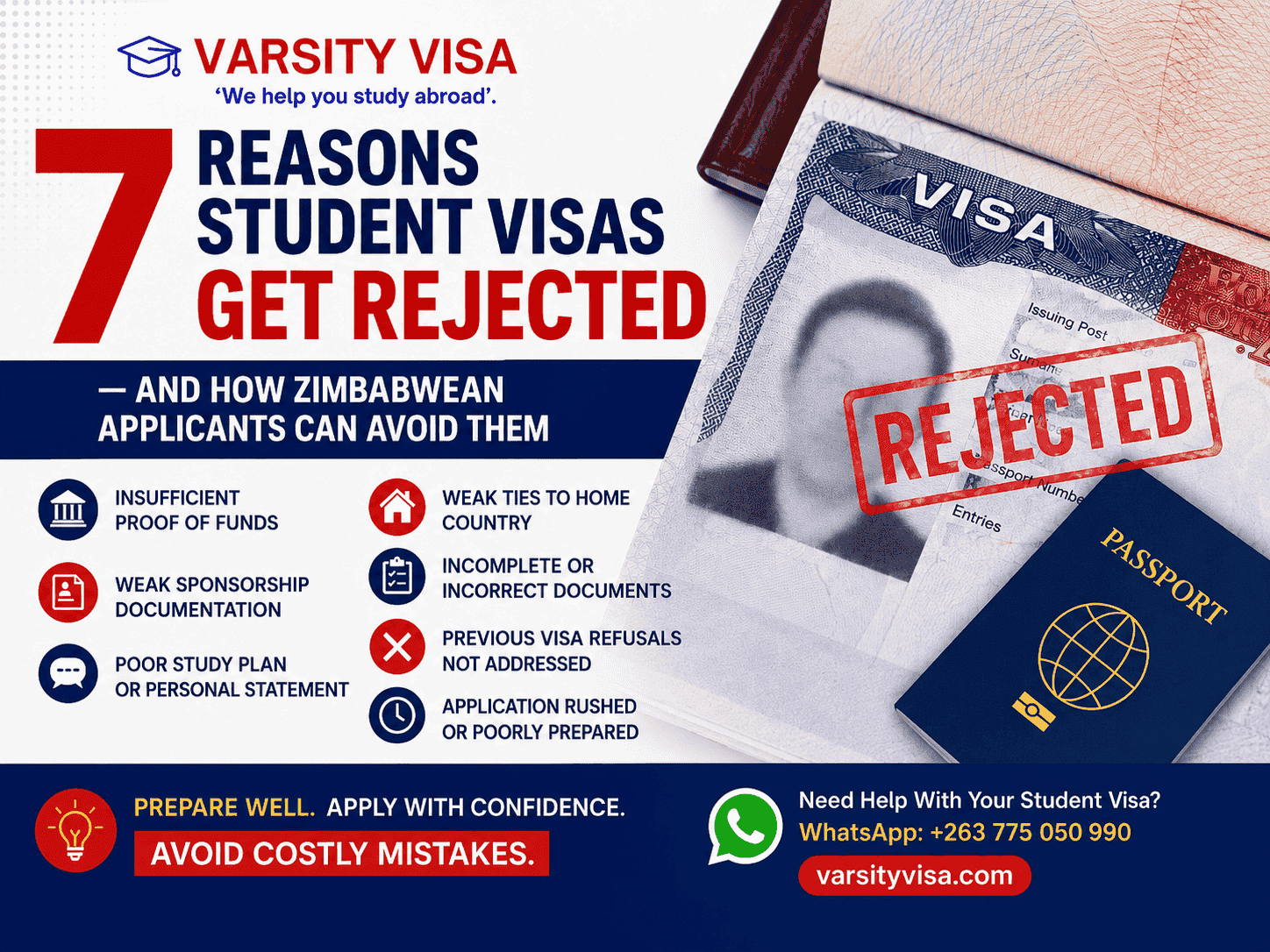
7 Reasons Student Visas Get Rejected — and How Zimbabwean Applicants Can Avoid Them
A student visa rejection is not just a delay. It can derail years of planning, cost a family thousands of dollars in non-refundable fees, and in some cases cause a student to lose a university place that cannot be held indefinitely.
For Zimbabwean families, this matters deeply.
By the time a student reaches the visa stage, money has often already been spent on applications, document preparation, tuition deposits, accommodation arrangements, medical insurance, travel planning, and consultancy fees.
A refusal can be painful.
But the hardest truth is this:
Many student visa refusals are preventable.
Not all of them. Some depend on embassy discretion, changing rules, appointment pressures, or country-specific requirements. But many refusals happen because the application was weak, rushed, inconsistent, or poorly explained.
This article explains seven common reasons student visas get rejected and what Zimbabwean applicants can do differently.
Quick Answer: Student visas often get rejected because of weak proof of funds, poor sponsorship documentation, an unclear study plan, weak home ties or future plans, incomplete documents, previous visa refusals that are not properly addressed, or rushed preparation.
Important: A complete visa file is not always a strong visa file. Every document must work together to prove that the student is genuine, financially prepared, academically credible, and realistic about the future.
What This Guide Covers
1. Why Student Visa Preparation Matters 2. Insufficient Proof of Funds 3. Weak Sponsorship Documentation 4. Study Plan Does Not Make Sense 5. Weak Home Ties or Future Plans 6. Incomplete or Incorrect Documents 7. Previous Visa Refusals Not Addressed 8. The Application Was Rushed 9. What to Do After a Rejection 10. Short Summary 11. How Varsity Visa Can Help 12. Frequently Asked Questions1. Why This Matters More for Zimbabwean Applicants
Visa officers at embassies across Europe, the UK, the Gulf, and other study destinations review thousands of applications every year.
Their role is not simply to approve students.
Their role is to assess risk.
They must decide whether the applicant genuinely meets the visa requirements, has a credible study plan, can afford the course, understands the purpose of travel, and is likely to comply with the visa conditions.
For Zimbabwean applicants, this process can be especially demanding.
That does not mean Zimbabwean students cannot succeed. Many do.
But it does mean the application must be prepared carefully.
A file that is merely complete may not be strong enough. A serious student visa application must be clear, consistent, well-documented, and believable from beginning to end.
If you are still deciding whether studying abroad is financially realistic, read our guide on the hidden cost of studying abroad for Zimbabwean families before committing to major payments.
2. Reason 1: Insufficient Proof of Funds
This is one of the most common reasons student visas are refused.
It is also one of the most misunderstood.
Many families think proof of funds simply means showing money in a bank account.
That is not enough.
Visa officers usually look beyond the final balance. They want to understand the story behind the money.
They may consider:
- How long the funds have been in the account
- Whether the balance has been stable
- Whether deposits are regular and explainable
- Whether the sponsor’s income supports the amount shown
- Whether the family can realistically sustain the student for the full period of study
- Whether the money appears borrowed or temporarily deposited
A bank account that suddenly receives a large amount shortly before the statement is printed can raise suspicion.
Even if the money is genuine, the application may look weak if the source is not properly explained.
What to Do Instead
Start preparing financial documents early.
Where possible, families should begin building a clear financial record several months before applying. Regular, explainable deposits are usually stronger than a sudden large balance with no supporting story.
If there is a large deposit, explain it clearly with evidence.
- Sale of property
- Business income
- Salary arrears
- Pension payout
- Family contribution
- Savings transfer
- Loan facility, where acceptable
- Fixed deposit maturity
Do not assume the visa officer will understand.
If something needs explanation, explain it before they question it.
Families considering Poland should also read our guide on Poland student visa requirements for Zimbabwean students because financial proof is one of the most important parts of the visa file.
3. Reason 2: Weak or Inconsistent Sponsorship Documentation
Most Zimbabwean students are sponsored by a parent, guardian, relative, employer, or family friend.
That is normal.
The problem begins when the sponsorship story is vague.
The embassy needs to understand who is paying, why they are paying, what they are paying for, and whether they can afford it.
Common sponsorship weaknesses include:
- Sponsor letter does not clearly state the relationship
- Sponsor does not specify which costs they will cover
- Sponsor income is informal and poorly documented
- Bank statements do not match the claimed income
- Multiple sponsors are listed without clear responsibility
- Business documents are missing or outdated
- Payslips and bank deposits do not align
- Sponsor appears financially stretched
- The student submits money without explaining where it came from
The issue is not only whether the sponsor has money.
The issue is whether the sponsor’s financial position is credible.
What to Do Instead
Your sponsorship documents must tell a coherent story.
A strong sponsor file may include:
- Detailed sponsorship letter
- Sponsor ID or passport copy
- Proof of relationship where applicable
- Bank statements
- Payslips or employment letter
- Business registration documents
- Tax documents where available
- Company bank statements where relevant
- Proof of assets where useful
- Explanation of large deposits
- Clear statement of the costs the sponsor will cover
The sponsor letter must not sound generic.
It should state who the sponsor is, their relationship to the student, what they do, how they earn income, what they are committing to pay, and why they are supporting the student.
Weak sponsorship documents create doubt. Clear sponsorship documents reduce doubt.
4. Reason 3: The Study Plan Does Not Make Sense
A student visa is not only about money.
The visa officer also wants to know whether the course choice makes sense.
They are asking:
Why this course? Why this university? Why this country? Why now?
If the answers are weak, the application becomes vulnerable.
A student with a commerce background applying for a completely unrelated programme must explain the transition.
A student choosing a less-known institution must explain why that university is suitable.
A student applying for a course that appears disconnected from their previous studies or career goals must show a logical academic and professional pathway.
Generic personal statements are dangerous.
A personal statement that could be used for any student, any course, any university, and any country is not persuasive.
It can make the applicant look like someone who is using education mainly as a relocation route.
What to Do Instead
Build a clear academic narrative.
The personal statement or cover letter should connect:
- The student’s academic background
- Previous subjects or qualifications
- Career interests
- Reason for choosing the programme
- Reason for choosing the university
- Reason for choosing the country
- Future plan after graduation
- How the qualification will be useful
Course choice affects admission, visa logic, future work options, and return-on-investment. Before choosing a programme, read our guide on the best courses to study in Poland in 2026 .
The story must hold together.
Do not write a motivational speech.
Write a logical explanation.
A visa officer does not need drama.
They need clarity.
5. Reason 4: Weak Evidence of Home Ties or Future Plans
One of the silent questions in many visa decisions is whether the applicant is likely to comply with visa conditions.
For many student visas, the officer may consider whether the applicant has a credible reason to return home or a lawful pathway after study.
This can be difficult for young applicants.
A 19-year-old student may not own property, have a spouse, run a business, or hold a permanent job.
That does not automatically mean refusal.
But it does mean the application should not ignore the question.
If the student has no clear future plan, the visa officer may conclude that the student is primarily using study as a migration route.
What to Do Instead
Address the future plan directly.
The student can strengthen the application by explaining:
- Career goals after graduation
- How the qualification is useful in Zimbabwe or the region
- Family ties in Zimbabwe
- Professional registration plans where applicable
- Business plans where relevant
- Employment sector they intend to enter
- Why the chosen course fits their future
Do not make false claims.
Do not invent property, jobs, or family obligations.
But do not leave the future plan blank.
Families should also think beyond the visa approval itself. Our article on hidden study abroad costs and post-graduation realities explains why families must understand what happens after graduation before spending thousands of dollars.
A weak future plan creates risk. A clear future plan creates confidence.
6. Reason 5: Incomplete or Incorrectly Formatted Documents
This is one of the most frustrating reasons for refusal because it is usually avoidable.
Every embassy has a document checklist.
But students often underestimate how strict those checklists can be.
Common documentation mistakes include:
- Bank statements not stamped or signed where required
- Incorrect passport photo size
- Expired admission letters
- Missing proof of tuition payment
- Missing accommodation confirmation
- Insurance that does not meet requirements
- Academic certificates not certified properly
- Translations missing where required
- Medical documents from unapproved facilities
- Incorrect visa application form
- Missing sponsor ID documents
- Documents uploaded in the wrong format
- Names or dates not matching across documents
A document can be present but still unacceptable.
That is the part many applicants miss.
What to Do Instead
Treat the embassy checklist as the minimum standard.
Before submission, verify:
- The latest official checklist
- Required document format
- Translation requirements
- Certification or notarisation rules
- Bank statement requirements
- Insurance requirements
- Photo specifications
- Appointment submission rules
- Payment confirmation rules
Do not rely only on social media advice or outdated information from other applicants.
Visa rules can change.
Embassy procedures can change.
A file should be reviewed carefully before submission, preferably by someone who understands the destination’s requirements.
For Poland applicants, the visa process should not be treated as separate from admission. Start with our guide on how to apply to Polish universities without wasting money because a weak admission pathway often creates a weak visa pathway.
7. Reason 6: Previous Visa Refusals Are Not Properly Addressed
A previous visa refusal does not always mean a new application will fail.
But hiding it can destroy the application.
Most visa forms ask whether the applicant has previously been refused a visa.
If the answer is yes, declare it.
Failure to declare a previous refusal can be treated as misrepresentation. That is far more serious than the original refusal.
The second mistake is declaring the refusal but not explaining what has changed.
If the previous refusal was due to weak funds, what has improved?
If it was due to unclear study purpose, how has the new application addressed it?
If documents were missing, are they now complete?
A previous refusal must be handled strategically.
What to Do Instead
Be honest and specific.
A stronger reapplication should include:
- The previous refusal letter
- A clear explanation of the refusal reason
- Evidence showing what has changed
- Stronger financial documents where needed
- Improved sponsor documentation
- Better personal statement or cover letter
- Corrected documents
- Updated admission or tuition evidence
- A more coherent study plan
Do not reapply with the same weak file. That is how one refusal becomes two. And two refusals make future applications harder.
8. Reason 7: The Application Was Rushed
This is the root cause behind many visa problems.
Rushed applications produce weak documents.
Rushed applications produce poor personal statements.
Rushed applications produce unexplained bank deposits.
Rushed applications produce missing translations, expired letters, inconsistent forms, and weak sponsor files.
A strong visa application is not built in one week.
In many cases, the financial record alone needs months of preparation.
The personal statement needs thought.
Sponsor documents need time.
Bank statements need to be reviewed.
Admission documents must be checked.
Insurance must match requirements.
Accommodation must be credible.
The file must be consistent.
What to Do Instead
Start visa preparation early.
If a student is planning to study abroad next year, visa thinking should begin now.
Not after the offer letter.
Not after tuition payment.
Not when the appointment opens.
Now.
The strongest applicants are not always the richest. They are often the most prepared.
9. What to Do If Your Student Visa Has Already Been Rejected
A visa refusal is painful, but it is not always the end.
In many cases, students can reapply.
But reapplying without fixing the reason for refusal is a serious mistake.
The refusal letter must be read carefully.
Ask:
- What exact reason was given?
- Was the issue financial?
- Was the issue documentation?
- Was the issue study purpose?
- Was the issue home ties?
- Was the issue previous visa history?
- Was the issue credibility?
- What evidence would directly address the concern?
- Is there enough time to reapply before the intake deadline?
If the reason is unclear, get professional advice before submitting again.
A second refusal is worse than the first because it creates a pattern.
It tells future visa officers that the same concern may still exist.
There is also the university issue.
Some universities may defer the student to the next intake.
Others may require a fresh application.
Some deposits may be refundable under certain conditions.
Others may not.
Before rushing into a reapplication, understand both the visa position and the university position.
10. The Short Version
The seven common reasons student visas get rejected are:
- Insufficient proof of funds — the balance exists, but the history is weak.
- Weak sponsorship documentation — the sponsor story is unclear or poorly supported.
- Study plan does not make sense — the course, country, and career path are not logically connected.
- Weak home ties or future plan — the application does not clearly explain what happens after graduation.
- Incomplete or incorrectly formatted documents — the file does not meet the embassy’s technical requirements.
- Previous visa refusals are not properly addressed — the applicant hides or fails to resolve past issues.
- The application was rushed — the root cause behind many avoidable mistakes.
Every one of these can be improved with enough time, proper review, and honest preparation.
11. Why Varsity Visa Focuses on Visa Readiness Before Submission
A student visa application is not just a form.
It is a case file.
Every document, statement, bank transaction, sponsor letter, and academic choice must work together to tell one believable story:
This student is genuine. The course makes sense. The funds are credible. The documents are complete. The plan is realistic.
If that story is weak, the visa is at risk.
If that story is strong, the student has a much better chance.
Need Help Reviewing Your Student Visa Application?
Varsity Visa Consultants helps Zimbabwean students and families prepare stronger study abroad applications before submission.
We assist with document review, sponsor guidance, personal statement strategy, financial readiness, visa preparation, and refusal recovery planning.
Send VISA REVIEW on WhatsApp.
WhatsApp +263 775 050 99012. Frequently Asked Questions
Why do student visas get rejected?
Student visas are commonly rejected because of weak proof of funds, unclear sponsorship documents, poor study plans, incomplete documents, weak future plans, previous refusals, or rushed preparation.
Is proof of funds only about the bank balance?
No. Visa officers may also consider account history, source of funds, regularity of deposits, sponsor income, and whether the funds appear stable and genuine.
Can I reapply after a student visa rejection?
In many cases, yes. But you should not reapply with the same weak file. The refusal reason must be understood and addressed before submitting again.
Does a previous visa refusal mean I will be rejected again?
Not always. A previous refusal is not automatically disqualifying, but it must be declared honestly and addressed with stronger evidence.
How early should I start preparing for a student visa?
Students should begin visa preparation as early as possible, ideally several months before submission, especially where proof of funds and sponsor documents need time to become credible.
Can Varsity Visa help with student visa preparation?
Yes. Varsity Visa helps Zimbabwean students and families with visa readiness, document review, sponsor guidance, personal statement strategy, financial preparation, and refusal recovery planning.

Prepare Well Before You Submit
Varsity Visa can help you assess your visa documents, sponsor readiness, financial proof, personal statement, admission documents, and refusal risks before submission.
Send VISA REVIEW on WhatsApp.
WhatsApp +263 775 050 990