
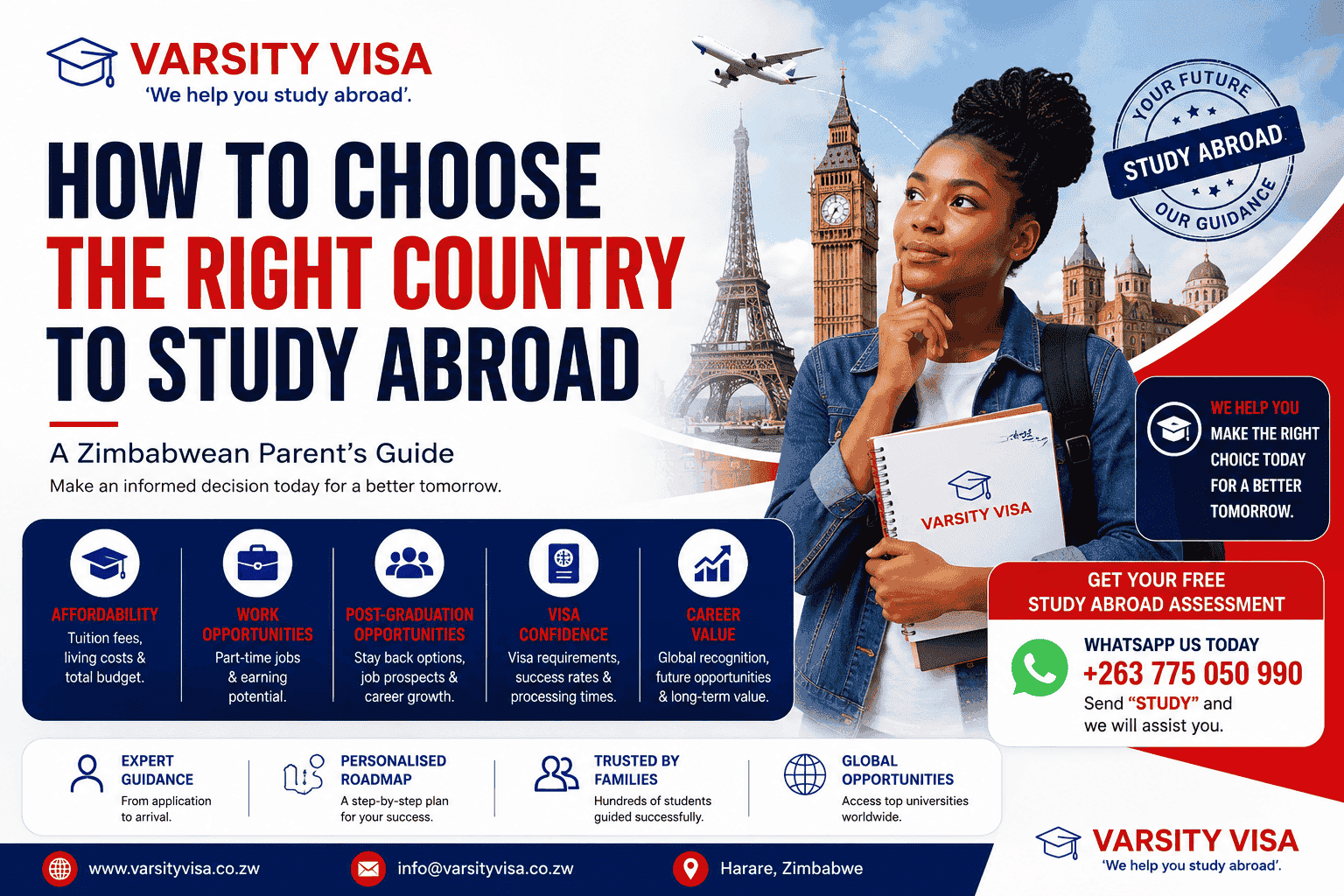
How to Choose the Right Country to Study Abroad: A Zimbabwean Parent's Guide
Choosing the right country is one of the most important decisions a Zimbabwean family will make when planning for a child to study abroad. The wrong country can lead to financial pressure, visa problems, limited work options, or a qualification that does not support the student's long-term goals.
Many families start by asking, "Which country is cheapest?" Others ask, "Which country has the easiest visa?" Those questions matter, but they are not enough.
The better question is this:
Which country gives this particular student the best balance of affordability, legal part-time work, visa confidence, post-graduation opportunity, and career value?
Quick Answer: Zimbabwean families should choose a study destination by comparing five factors: affordability, part-time work opportunities, post-graduation options, visa confidence, and career value. A country is not automatically good because it is popular, cheap, or in Europe. The right destination depends on the student's qualifications, budget, programme choice, documentation strength, and long-term plan.
Important: Do not choose a country based only on social media posts, agent posters, or what another student did. A destination that worked for one family may be unsuitable for another family with a different budget, qualification, sponsor, or career goal.
Free Checklist: Study Abroad Country Decision Checklist
Before paying application fees or tuition deposits, use our checklist to compare countries based on tuition, living costs, work opportunities, visa requirements, post-study options, and long-term career value.
Send COUNTRY CHECKLIST on WhatsApp.
WhatsApp +263 775 050 990What This Guide Covers
1. Why the Country Decision Matters 2. The Biggest Mistake Families Make 3. The Varsity Visa Five-Factor Framework 4. Affordability 5. Part-Time Work Opportunities 6. Post-Graduation Opportunities 7. Visa Confidence 8. Career Value 9. How to Compare Countries Properly 10. Warning Signs Before Choosing a Country 11. Questions Parents Should Ask 12. How Varsity Visa Can Help 13. Frequently Asked Questions1. Why the Country Decision Matters
Studying abroad is not just about getting an admission letter. It is a major financial and life decision. For many Zimbabwean families, it may involve savings, support from relatives, selling assets, borrowing money, or long-term sacrifice.
That is why choosing the country must be done carefully.
The country affects:
- The tuition fees the family will pay
- The cost of living the student must manage
- The visa process and documentation required
- Whether the student can work legally while studying
- Whether the student has options after graduation
- The recognition and usefulness of the qualification
- The student's safety, adjustment, and support system
A country that looks cheap in a poster may become expensive once accommodation, food, insurance, flights, visa fees, winter clothes, and emergency costs are added.
2. The Biggest Mistake Zimbabwean Families Make
The biggest mistake is starting with the country instead of starting with the student.
Many families begin by saying:
- "We want Europe."
- "We want Canada."
- "We want Germany."
- "We heard Poland is good."
- "Someone said Georgia is cheaper."
But the real starting point should be:
- What qualifications does the student have?
- What programme does the student want to study?
- What is the realistic family budget?
- Does the student need part-time work?
- Does the family want a country with post-graduation options?
- How strong are the student's documents?
- What is the long-term career goal?
Varsity Visa Insight: In our experience, families who first understand the student's profile make better decisions than families who chase the most popular country of the moment.
3. The Varsity Visa Five-Factor Framework
At Varsity Visa, we recommend evaluating every study destination using five major factors:
| Factor | What It Means | Why It Matters |
|---|---|---|
| Affordability | Tuition, living costs, travel, documents, and emergency budget | The family must be able to sustain the journey |
| Part-Time Work | Whether students can work legally while studying | Work can reduce pressure, but should not replace proper budgeting |
| Post-Graduation Options | Possibility of staying, working, or progressing after studies | The degree should support life after graduation |
| Visa Confidence | Documentation, sponsor strength, visa trends, and processing risks | Admission is useless if the visa pathway is weak |
| Career Value | Recognition, employability, and long-term usefulness of the qualification | Studying abroad should improve the student's future |
4. Affordability: Can the Family Sustain the Journey?
Affordability is not only about tuition fees. A university may charge affordable tuition, but the full journey may still be expensive.
Families should calculate:
- Tuition fees
- Accommodation
- Food
- Transport
- Medical insurance
- Visa fees
- Flights
- Winter clothing
- Document processing
- Emergency funds
A destination with tuition between US$3,000 and US$5,000 may be attractive to many Zimbabwean families. But the family must still calculate the full first-year cost.
Common mistake: Comparing countries using tuition only. The correct comparison is total first-year cost and total programme sustainability.
5. Part-Time Work Opportunities: Can Students Work Legally?
For many Zimbabwean families, the ability to work part-time is one of the strongest reasons for choosing a destination.
However, families must be realistic.
Part-time work can help with living expenses, but it should not be treated as a guaranteed way to pay all tuition and living costs.
Before choosing a country, ask:
- Are international students legally allowed to work?
- How many hours can they work?
- Are student jobs available in practice?
- Does the student need local language skills?
- Can the student balance work and studies?
Varsity Visa Insight: Parents are right to ask about part-time work. But the safer planning approach is to budget properly first, then treat part-time work as support, not as the entire financial plan.
6. Post-Graduation Opportunities: What Happens After the Degree?
A good study destination should not only help the student enter university. It should also support the student's future after graduation.
Parents should ask:
- Can graduates stay after completing studies?
- Are there graduate work permits or residence options?
- Are there realistic job opportunities?
- Does the country need skills in the student's field?
- Can the student progress to further studies?
Studying abroad is an investment. Families should evaluate the possible return on that investment.
7. Visa Confidence: Can the Student Actually Get There?
One of the most painful situations is when a student receives an offer letter but fails at the visa stage.
Before choosing a country, families should understand:
- Financial proof required
- Sponsor documentation
- Medical requirements
- Police clearance requirements
- Interview expectations
- Processing timelines
- Recent visa trends
If you want to understand visa risk in more detail, read our guide: 7 Reasons Student Visas Get Rejected — and How Zimbabwean Applicants Can Avoid Them .
Important: Admission is not the same as visa approval. A strong study abroad plan must consider both.
8. Career Value: Will the Qualification Help the Student's Future?
The final factor is career value.
A country may be affordable. A student may be admitted. The visa may even be possible. But the question remains:
Will this qualification improve the student's long-term future?
For regulated professions such as medicine, nursing, pharmacy, law, engineering, teaching, and accounting, families should also check recognition and professional registration implications.
For general business, IT, hospitality, and social science programmes, families should still consider employability and career direction.
9. How to Compare Countries Properly
A proper comparison should be structured. Do not simply say one country is better than another.
| Question | Why It Matters |
|---|---|
| Can we afford the first year? | The first year is often the most expensive because of travel, setup costs, and documents. |
| Can we afford the full programme? | A cheap start is dangerous if the family cannot sustain year two or year three. |
| Can the student work legally? | Part-time work can reduce pressure but should not replace family support. |
| What happens after graduation? | Post-study options affect the return on investment. |
| How predictable is the visa pathway? | Weak documentation can lead to refusal even with admission. |
| Is the qualification useful? | The degree must support employment, further study, or professional registration. |
10. Warning Signs Before Choosing a Country
Be careful if you hear statements like:
- "Visa is guaranteed."
- "You do not need to show any money."
- "You can work and pay everything yourself."
- "This country accepts everyone."
- "Do not worry about recognition."
- "Just pay quickly before the offer closes."
No serious consultant should promise what embassies, universities, employers, or immigration authorities control.
11. Questions Every Zimbabwean Parent Should Ask
- What is the total first-year cost?
- What is the total cost until graduation?
- Can my child work legally while studying?
- What documents are needed for the visa?
- What are the current visa risks?
- What happens after graduation?
- Is the qualification recognised or useful?
- Is the student academically ready?
- Is the student emotionally ready?
- What is the backup plan if the visa is refused?
12. How Varsity Visa Can Help
Varsity Visa helps Zimbabwean students and families choose suitable international study pathways based on academic eligibility, budget, career goals, visa readiness, recognition, post-graduation options, and realistic planning.
We do not believe families should choose countries blindly. We believe they should first understand the student's profile, the family's budget, and the long-term goal.
Need Help Choosing the Right Country?
Before you apply anywhere, book a Varsity Visa Study Abroad Readiness Assessment. We will help you compare countries based on affordability, work opportunities, visa confidence, post-graduation options, and career value.
Send ASSESSMENT on WhatsApp.
WhatsApp +263 775 050 99013. Frequently Asked Questions
Which country is best for Zimbabwean students?
There is no single best country for every student. The right country depends on the student's qualifications, budget, chosen programme, visa readiness, and long-term career goals.
Should I choose the cheapest country?
Not automatically. A cheap country can still become expensive if the cost of living is high, student work is limited, or the visa pathway is risky.
Can Zimbabwean students work while studying abroad?
Many countries allow international students to work part-time, but the rules differ by country. Families should confirm the legal work rights before applying.
Is Europe always better for studying abroad?
Not always. Europe can offer strong opportunities, but the best choice depends on affordability, visa requirements, work rights, recognition, and the student's goals.
What should parents check before paying tuition?
Parents should check total cost, visa requirements, university recognition, refund policy, accommodation, work rights, and post-graduation options.
Can Varsity Visa help us compare countries?
Yes. Varsity Visa helps families compare suitable destinations through a Study Abroad Readiness Assessment based on the student's profile and family budget.