
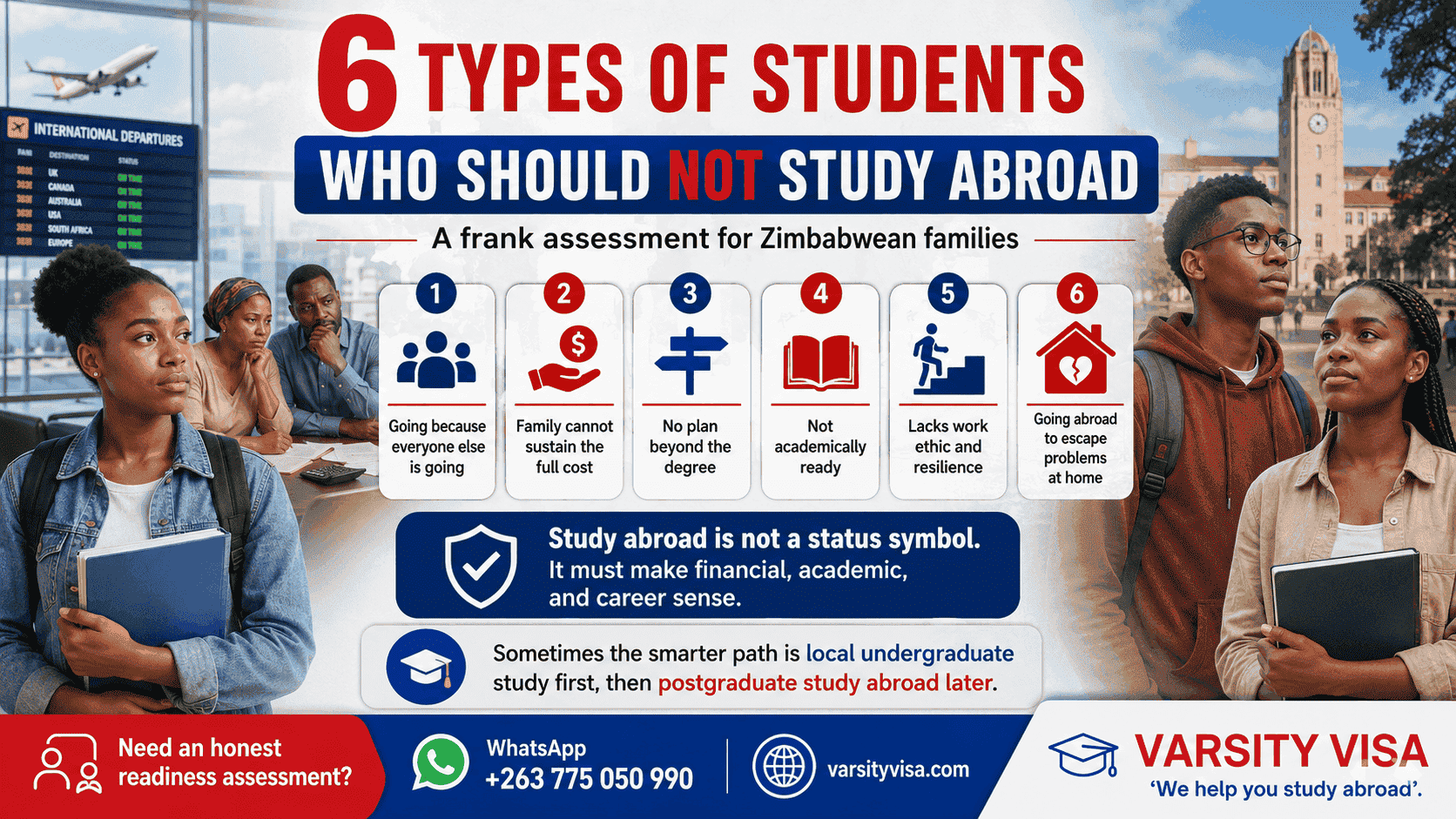
6 Types of Students Who Should Not Study Abroad — A Frank Assessment for Zimbabwean Families
Most study abroad content tells students why they should go abroad. This article does the opposite. It explains when a student should not study abroad — at least not yet.
Not because studying abroad is a bad decision.
For the right student, with the right preparation, the right finances, and the right plan, studying abroad can be life-changing.
But for the wrong student, at the wrong time, for the wrong reason, studying abroad can become an expensive mistake.
It can cost a family thousands of dollars. It can place pressure on a student who is not ready. It can lead to academic failure, visa problems, financial stress, or a painful return home with very little to show for the sacrifice.
Not every student who can go abroad is ready to go abroad.
This article is written to help Zimbabwean students and families think honestly before committing money to applications, tuition deposits, visas, flights, and accommodation.
Quick Answer: A student may not be ready to study abroad if they are going because of social pressure, if the family cannot sustain the full cost, if there is no plan beyond the degree, if the student lacks academic independence, if the student lacks the discipline to balance work and study, or if they are trying to escape problems at home rather than move toward a clear opportunity.
Important: Studying abroad is not automatically wise because it is international. The decision must make financial, academic, emotional, visa, and career sense.
Free Download: Study Abroad Readiness Checklist
Before paying application fees or tuition deposits, use our readiness checklist to assess motivation, finances, academic maturity, visa readiness, work ethic, and post-graduation planning.
This checklist is designed for Zimbabwean parents who want an honest answer before committing thousands of dollars.
Download the Free ChecklistOr send READINESS CHECKLIST on WhatsApp.
WhatsApp +263 775 050 990What This Guide Covers
1. Why a Study Abroad Consultant Is Writing This 2. Going Because Everyone Else Is Going 3. Keeping Up With the Joneses 4. Family Cannot Sustain the Full Cost 5. Do Not Depend on Imaginary Part-Time Work 6. No Plan Beyond the Degree 7. Not Academically Prepared 8. Lacks Work Ethic and Resilience 9. Going Abroad to Escape Problems 10. Studying Abroad Later May Be Wiser 11. What This Means for Families 12. What Readiness Looks Like 13. How Varsity Visa Can Help 14. Frequently Asked Questions1. Why a Study Abroad Consultant Is Writing This Article
Varsity Visa helps Zimbabwean students study abroad.
That is part of what we do.
So it may seem unusual for us to publish an article about students who should not go.
But here is the reason.
Over time, we have seen a clear pattern: the students who struggle most abroad are not always the students with the weakest academic results.
Many are capable students. Some are bright. Some come from supportive families. Some even have the money.
The problem is that they went abroad at the wrong time, for the wrong reason, with the wrong level of preparation.
A student who leaves Zimbabwe without a clear goal, without financial stability, without emotional readiness, or without a realistic post-graduation plan may not just have a difficult experience.
They may fail modules. They may lose student status. They may place their family under heavy financial pressure. They may return home after years of sacrifice with an outcome that does not justify the investment.
We would rather tell a family the truth before departure than watch them discover it after spending thousands of dollars.
This article is not written to discourage ambition.
It is written to separate ambition from poor timing.
2. Type 1: The Student Who Is Going Because Everyone Else Is Going
In some circles, studying abroad has become a status symbol.
A cousin goes to Poland. A church member’s child goes to Malaysia. A neighbour’s daughter goes to Georgia. Another family posts airport photos on Facebook.
Slowly, pressure builds.
Parents begin to feel that if their child does not study abroad, they are falling behind.
Students begin to feel that staying in Zimbabwe means they are not ambitious enough.
That is dangerous thinking.
Studying abroad should not be a social reaction.
It should be a strategic decision.
The students most at risk are the ones who cannot explain clearly why they personally want to study abroad.
When asked why they want to go, they say things like:
- “Everyone is going.”
- “There are better opportunities outside.”
- “My cousin went.”
- “Zimbabwe has no future.”
- “I just want to leave.”
- “People are saying Poland is good.”
- “My parents want me to go.”
Those are not strong enough reasons.
They are emotions, impressions, and borrowed opinions.
A student needs a reason that belongs to them.
When the excitement fades, the student will still have to face cold weather, loneliness, difficult coursework, culture shock, homesickness, language barriers, financial pressure, and independent living.
At that point, social pressure will not sustain them.
Question to ask: If none of your friends, relatives, or church members had ever gone abroad, would you still want to go? Why?
If the student cannot answer that question clearly, they may not be ready.
3. The Danger of “Keeping Up With the Joneses”
There is another pressure many families rarely admit openly.
Social pressure.
Sometimes the decision to send a child abroad is not driven by the student’s career plan, academic readiness, or family finances.
It is driven by comparison.
Another family sent their child to Poland. A neighbour’s child is in Malaysia. A church member’s daughter is studying in Georgia. A relative keeps posting airport photos, graduation pictures, and videos from overseas.
Slowly, parents begin to feel left behind.
They start thinking:
- “People will think we are failing our child.”
- “Other families are progressing.”
- “Our child must also go abroad.”
- “We cannot be seen as less successful.”
- “If we do not send our child, people will think we cannot afford it.”
This is what people often call “keeping up with the Joneses.”
It means making financial decisions because you want to appear to be at the same social level as other people.
That is dangerous.
Studying abroad should not be used as a symbol of social class.
It should be an education and career strategy.
A family can look successful publicly while suffering privately under debt, pressure, and financial instability.
Parents must be honest with themselves.
Are we sending this child abroad because it is the best path for them?
Or are we sending them because we do not want to look behind other families?
That question may be uncomfortable.
But it can save a family from spending thousands of dollars for the wrong reason.
4. Type 2: The Student Whose Family Cannot Sustain the Full Cost
Many Zimbabwean families stretch financially to send a child abroad.
That is normal.
Education often requires sacrifice.
The problem is not sacrifice.
The problem is a financial plan that only works if everything goes perfectly.
That is not a plan.
That is hope.
A family may calculate the first year carefully:
- Tuition covered
- Visa fees covered
- First flight covered
- First few months of accommodation covered
- Basic living expenses estimated
Then reality begins.
A sponsor’s business slows down. A parent loses income. A medical emergency affects the family. Exchange rates shift. Accommodation costs rise. The student fails a module and needs to pay resit fees. The university increases fees.
Suddenly, the student is in another country, mid-degree, and the financial floor starts moving.
The consequences can be serious.
A student who cannot pay fees may lose student status. A student who loses student status may lose visa rights. A student who loses visa rights may need to leave the country.
By that stage, the family may have already spent thousands of dollars that cannot be recovered.
This is why families must calculate the full cost, not just the first payment.
For a deeper breakdown, read our article on the hidden cost of studying abroad for Zimbabwean families .
Honest test: Can the family still sustain the student if the main sponsor’s income drops by 30% for one year?
If the answer is no, the family may not be ready to commit.
They may be ready to plan.
That is different.
5. Do Not Build the Budget Around Imaginary Part-Time Work
Part-time work can help some international students.
But it should not be the foundation of the family’s study abroad budget.
Some families say:
“We only have enough for the first year, but the student will work and figure it out when they get there.”
That is not a financial plan.
That is transferring risk from the family to the student.
There are several reasons this is dangerous.
- Work rights depend on the country and visa conditions.
- Getting a job is not guaranteed.
- The income may not be enough to cover tuition and living costs.
- Jobs may be limited, competitive, or physically demanding.
- Excessive work can damage academic performance.
- The student may not have the discipline or resilience to balance work and study.
Some students manage part-time work well.
They are disciplined, mature, and resilient.
But families must not build a budget around a version of the student that does not yet exist.
If the student has never shown strong work ethic at home, it is dangerous to assume they will suddenly develop it abroad under pressure.
Part-time work should be treated as support, not survival.
The core budget should still make sense even if the student does not find work immediately.
6. Type 3: The Student With No Plan Beyond the Degree
A degree is not a destination.
A degree is a tool.
The real question is:
What will the student do with it?
Many families focus on getting admission.
Then they focus on getting the visa.
Then they focus on departure.
But they never seriously ask what happens after graduation.
That is a major mistake.
Some students complete degrees abroad and only later discover that the qualification does not automatically unlock the career path they expected.
This is especially serious in regulated professions such as:
- Medicine
- Nursing
- Pharmacy
- Law
- Engineering
- Accounting
- Architecture
- Teaching in some countries
For these professions, graduating is not always enough.
The student may still need professional registration, licensing exams, degree assessment, supervised practice, internship, board approval, or local conversion requirements.
A medical degree from abroad may still need recognition and professional registration before the graduate can practise.
We explained this in detail in our guide on Poland vs Georgia for medicine and the recognition questions Zimbabwean families must ask .
The questions should be asked before departure:
- Where does the student want to work after graduation?
- Does the qualification support that pathway?
- Is the degree recognised where the student wants to practise?
- Will professional registration be required?
- Are there licensing exams?
- Is internship required?
- What happens in the first 12 months after graduation?
- Who funds that transition period?
The degree is not the plan.
The degree is the instrument.
The plan is what the student intends to build with it, where, and how.
7. Type 4: The Student Who Is Not Academically Prepared for the Transition
A student can be intelligent and still not be ready for university abroad.
That is not an insult.
It is reality.
Zimbabwe’s education system can produce disciplined, exam-focused students. Many perform very well at O-Level and A-Level.
But success in Zimbabwe does not automatically translate into success abroad.
In many overseas universities, students are expected to manage:
- Independent study
- Large reading volumes
- Self-directed learning
- Research assignments
- Continuous assessment
- Group work
- Presentations
- Online learning systems
- Practical work
- Less direct teacher follow-up
- A faster academic pace
In demanding programmes such as medicine, engineering, computer science, pharmacy, and nursing, the pressure can be intense.
A student who is used to being closely guided may struggle when no one is checking daily whether they are falling behind.
A student who relies only on memorisation may struggle where reasoning, application, and independent problem-solving are expected.
Academic difficulty can also affect visa stability. We covered visa risk in more detail in our guide on why student visas get rejected and how Zimbabwean applicants can avoid them .
Question to ask: How does this student perform when there is no teacher checking in, no structured schedule, and no immediate consequence for falling behind?
Marks matter.
But maturity matters too.
8. Type 5: The Student Who Lacks the Work Ethic to Survive Abroad
Some families make a dangerous assumption.
They say:
“We will pay the first-year fees. When the student gets there, they will work, hustle, and support themselves.”
That plan may work for some students.
But it should never be treated as guaranteed.
Studying abroad is already demanding.
The student must attend classes, complete assignments, prepare for exams, manage immigration requirements, cook, clean, budget, travel, and adjust to a new country.
Adding work pressure on top of that can be extremely difficult.
Some students manage it well.
They are disciplined, mature, resilient, and willing to do difficult work.
But not every student has that level of discipline.
Some students struggle even when everything is provided for them.
They need constant reminders. They avoid difficult tasks. They procrastinate. They lack consistency. They are not used to pressure. They give up quickly when things become uncomfortable.
That kind of student should be very careful about studying abroad, especially if the family does not have enough money to support the full journey.
The idea of “hustling abroad” sounds attractive when people say it casually.
But the reality can be harsh.
- The student may need to study during the day and work evenings or weekends.
- They may have to take physically tiring jobs.
- They may have to work in cold weather.
- They may face rejection when looking for part-time work.
- They may discover that jobs are limited or restricted by visa conditions.
- They may earn less than expected.
- They may still need money from home.
- They may become so tired from working that their academic performance drops.
And if academic performance drops, the whole study abroad plan becomes unstable.
Hard question: Is this student truly disciplined enough to study abroad and work at the same time?
Not every student is.
That is not an insult.
It is a planning issue.
A student who cannot work hard in Zimbabwe should not assume they will suddenly become hardworking in Poland, Malaysia, Georgia, Dubai, or anywhere else.
Families must not build a financial plan around a version of the student that does not yet exist.
Ambition is not enough.
A student who studies abroad with limited financial support needs stamina, resilience, discipline, humility, and maturity.
9. Type 6: The Student Going Abroad to Escape a Problem at Home
This is the most sensitive category.
Some students want to study abroad because they are moving toward a clear opportunity.
Others want to go because they are running away from something.
That something may be:
- Family conflict
- Disappointment after poor results
- A broken relationship
- Social embarrassment
- Pressure from relatives
- Lack of direction
- Emotional stress
- A desire to disappear and start again
Studying abroad can bring a fresh environment.
But it does not automatically solve internal problems.
A student who lacks direction in Zimbabwe may still lack direction in Poland.
A student who is overwhelmed at home may feel even more alone abroad.
A student who is running away from pressure may find a different kind of pressure overseas.
In many cases, the challenges become heavier because the student is now far from familiar support systems.
This does not mean students with personal challenges cannot succeed abroad.
Many can.
But they need honest preparation and support.
Departure should not be used as a substitute for dealing with the real issue.
Question to ask: Is this student going toward something specific, or away from something uncomfortable?
10. Studying Abroad Later May Be Wiser Than Studying Abroad Now
Not every student needs to study abroad immediately after high school.
For some families, the wiser strategy may be to start locally or regionally, then consider studying abroad later.
For example, a student may complete an undergraduate degree at a recognised local university while the family uses those years to:
- Strengthen its financial position
- Build savings
- Prepare stronger sponsor documents
- Clarify the student’s career direction
- Improve academic maturity
- Research countries and universities more carefully
- Prepare for postgraduate study abroad
- Avoid unnecessary debt or financial pressure
Then, when the student is more mature and the family is more stable, they may pursue a master’s degree, professional programme, or specialised postgraduate qualification abroad.
That can be a smarter route.
Studying abroad is not valuable simply because it happens early.
It is valuable when it fits the student’s goals, the family’s finances, and the long-term plan.
A family that cannot afford four or five years abroad for undergraduate study may still be able to afford one or two years abroad for postgraduate study later.
That does not mean the family has failed.
It means the family is being strategic.
Sometimes the best study abroad plan is not: “Go now.”
Sometimes the best plan is: “Prepare properly, study locally first, then go abroad when the timing and finances are stronger.”
11. What This Means for Families
If you recognise your situation in one of these six categories, it does not automatically mean the student should never study abroad.
It may simply mean the timing is wrong.
That is not failure.
That is wisdom.
Some students need one more year to strengthen their academic readiness.
Some families need time to improve their financial position.
Some students need better career guidance before choosing a course.
Some need to understand recognition pathways before selecting a regulated profession.
Some need emotional support before leaving home.
Some need to develop independence and work ethic.
Waiting is not always losing time.
Sometimes waiting protects the investment.
12. What Readiness Actually Looks Like
A student who is genuinely ready to study abroad does not need to be perfect.
But there are signs of readiness.
A ready student usually:
- Can explain why they want to study abroad in specific terms
- Understands what course they want and why
- Has a realistic post-graduation plan
- Knows where they may want to work after graduation
- Understands recognition or licensing issues where relevant
- Has a family financial plan that covers more than year one
- Can work independently without constant supervision
- Can ask for help before problems become serious
- Has the discipline to manage study, life, and possibly work
- Is going toward a clear opportunity, not only away from frustration
- Has thought about what happens if things do not go as planned
No student meets every criterion perfectly.
That is not the standard.
The standard is honest self-assessment, adequate preparation, and a plan based on reality rather than wishful thinking.
A Better Way to Think About Studying Abroad
The wrong question is:
Can we send the student abroad?
The better question is:
Should we send the student abroad now, for this course, in this country, with this budget, and this post-graduation plan?
That is the real decision.
Studying abroad is not automatically wise because it is international.
A local or regional option may be better for some students.
A gap year may be better for others.
A diploma pathway may be better than a degree pathway.
A lower-cost country may be better for one family.
A more expensive but more suitable country may be better for another.
Good education planning is not about forcing every student abroad.
It is about choosing the pathway that makes sense.
13. Need an Honest Study Abroad Readiness Assessment?
Varsity Visa helps Zimbabwean students and families decide whether studying abroad makes sense for their specific situation.
We can help you assess:
- Academic readiness
- Course suitability
- Destination fit
- Full financial commitment
- Visa readiness
- Sponsor strength
- Recognition and professional registration issues
- Post-graduation planning
- Whether the timing is right
If we believe the timing is not right, we will tell you.
Our goal is not to send every student abroad.
Our goal is to help every family make the right decision.
Download the Study Abroad Readiness Checklist
Use this checklist to assess whether the student is truly ready before you pay application fees, tuition deposits, or visa costs.
Download Free Checklist Get It on WhatsAppNeed a Readiness Review?
Before committing thousands of dollars to applications, visas, tuition, or flights, get an honest assessment of whether studying abroad makes sense for your family right now.
Send READINESS REVIEW on WhatsApp.
WhatsApp +263 775 050 99014. Frequently Asked Questions
Should every student study abroad if the family can afford it?
No. Affordability is important, but it is not the only factor. The student also needs academic readiness, emotional maturity, a clear goal, visa readiness, and a realistic post-graduation plan.
Is studying abroad always better than studying locally?
No. For some students, studying locally first and going abroad later for postgraduate studies may be more strategic and financially safer.
Can a student rely on part-time work abroad to pay tuition?
This is risky. Part-time work is not guaranteed, may be restricted by visa rules, and may not pay enough to cover tuition and living costs. It should support the budget, not carry the whole plan.
What if a student wants to study abroad because everyone else is going?
That is not a strong enough reason. The student should have a personal, specific, and strategic reason for studying abroad.
Is delaying study abroad a failure?
No. Delaying can be wise if it gives the family time to strengthen finances, clarify career goals, improve academic readiness, or prepare better documents.
Can Varsity Visa help assess if a student is ready?
Yes. Varsity Visa helps Zimbabwean students and families assess academic readiness, financial readiness, visa readiness, course fit, destination fit, and post-graduation planning.

Make the Right Decision Before You Pay
Studying abroad should be driven by clarity, readiness, preparation, and a realistic plan — not fear, pressure, comparison, or escape.
Send READINESS REVIEW on WhatsApp.
WhatsApp +263 775 050 990