
How to Apply to a University in Georgia: Step-by-Step Guide
A practical roadmap from choosing a Georgian university and preparing your documents to foreign-education recognition, final admission, tuition payment, the D3 student visa and travel to Georgia.
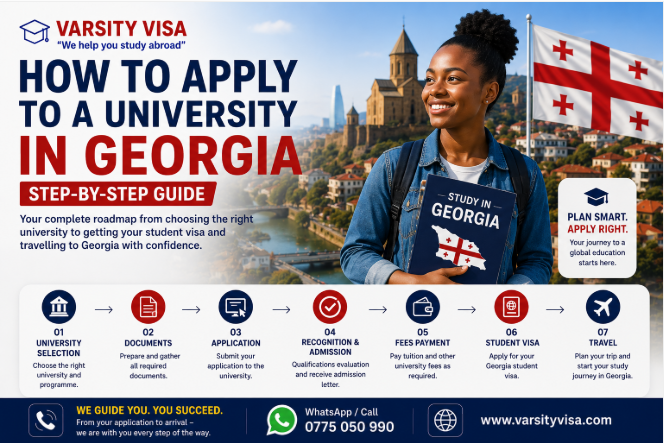
Applying to study in Georgia is not simply a matter of filling in one form.
International students normally move through several separate stages:
- Choosing a suitable university
- Selecting the right programme
- Checking admission eligibility
- Preparing academic documents
- Submitting the university application
- Completing foreign-education recognition where required
- Receiving final admission documentation
- Paying the required university fees
- Applying for the D3 student visa
- Travelling to Georgia
- Completing residence formalities after arrival where applicable
For a complete overview of studying in Georgia, read: Study in Georgia for Zimbabwean Students: Complete Guide .
Georgia University Application Process at a Glance
Your Georgia Study Journey
Step 1: Decide Whether Georgia Fits Your Study Goals
Before applying anywhere, ask whether Georgia is actually suitable for:
- Your programme
- Your academic background
- Your budget
- Your career plan
- Your preferred language of instruction
- Professional recognition requirements
Step 2: Choose the Right Georgian University
Georgia has multiple authorised higher education institutions offering programmes to international students.
Compare universities using:
Programme Availability
Confirm that the university actually offers your intended programme in the language you need.
Authorisation & Accreditation
Check the institution and programme through the appropriate Georgian education-quality framework.
Tuition
Compare the complete university fee rather than relying on promotional advertising.
Location
Consider accommodation, public transport, living expenses and access to campus.
Step 3: Choose the Correct Programme
Georgia offers English-taught programmes across areas including:
- Medicine
- Dentistry
- Pharmacy
- Computer Science
- Information Technology
- Engineering
- Business
- Management
- Public Health
- International Relations
- Other fields
The right programme depends on your subjects, grades and future career.
Read: Best Courses to Study in Georgia for International Students .
Step 4: Check Your Admission Eligibility
Do this before paying application or processing fees.
The university may assess:
- Highest qualification
- Secondary-school completion
- O-Level subjects and grades
- A-Level subjects where applicable
- Diploma or degree results
- Programme-specific subjects
- English ability
O-Level applicants
Students with O-Level should not assume they automatically qualify for direct Bachelor's admission.
See: Can You Study in Georgia with O-Levels? .
Medicine applicants
Biology, Chemistry and other science preparation can be important.
Engineering applicants
Mathematics and Physics may be particularly relevant.
Step 5: Prepare Your Application Documents
The exact list varies by university and level of study.
Common documents may include:
- Valid passport
- Passport photograph
- O-Level certificate
- A-Level certificate where applicable
- Secondary-school transcript
- Diploma where applicable
- Bachelor's degree for postgraduate applicants
- Academic transcripts
- English-language evidence where required
- CV for some postgraduate programmes
- Motivation letter where required
- Recommendation letters where required
Step 6: Submit the University Application
Georgia's official international-study portal advises prospective students to contact the international office of their chosen university.
Depending on the university, the application may be submitted:
- Through an online application portal
- By email to the international admissions office
- Through an authorised representative
- Through another official university process
Step 7: Complete Any Interview or Entrance Assessment
Some universities may conduct an online interview or assessment before final admission.
The university may assess:
- English communication
- Academic readiness
- Motivation
- Programme understanding
- Relevant subject knowledge
Step 8: Complete Recognition of Foreign Education
This is one of the most important stages for international applicants.
Georgia's National Center for Educational Quality Enhancement — EQE — handles recognition of education obtained abroad.
EQE verifies:
- Whether the educational document is authentic
- Whether the issuing institution is recognised in its home country
- Whether the qualification corresponds to qualifications in Georgia
- Relevant learning outcomes or education level
Recognition documents
EQE's current guidance includes documents such as:
- Application
- Identity document
- Passport copy with notarised translation where required
- Educational documents
- Supporting documentation requested during verification
Step 9: Receive Final Admission Documentation
After the relevant academic and recognition requirements have been satisfied, the university can issue the applicable final admission or enrolment documentation.
Students should distinguish between:
| Stage | Meaning |
|---|---|
| Initial Assessment | The university reviews whether your application appears eligible. |
| Conditional Offer | Admission may depend on outstanding documents, recognition, language or other conditions. |
| Recognition Completed | The applicable foreign-education recognition requirement has been processed. |
| Final Admission | The university confirms that admission conditions have been satisfied. |
| Visa Approval | The Georgian immigration authorities separately approve the immigration application. |
Step 10: Pay the Required University Fees
The university may require payment before issuing certain documents or before the visa stage.
Before transferring money, confirm:
- Exact tuition amount
- Amount due before arrival
- University bank details
- Payment reference
- Refund policy
- Whether additional university fees apply
For budgeting, read: Cost of Studying in Georgia for International Students .
Step 11: Apply for the Georgia D3 Student Visa
Foreign citizens coming to Georgia for long-term study at an authorised educational institution generally use the D3 immigration visa.
Georgia's official D3 guidance states that the visa is generally:
- Issued for long-term study
- Valid for 90 days
- Multiple entry
Core documentation includes:
- Completed visa application
- Passport
- Photograph
- Consular fee evidence
- University study-purpose documentation
- Financial evidence
- Accommodation evidence
- Health insurance
Read our full guide: Georgia Student Visa Requirements for Zimbabwean Students .
Step 12: Prepare to Travel to Georgia
Travel planning should start after the appropriate immigration approval.
Before departure, prepare:
- Passport
- Visa documentation
- University admission documents
- Tuition-payment evidence
- Accommodation confirmation
- Health insurance
- Flight booking
- Airport transfer plan
- Emergency funds
- Copies of important documents
Step 13: What Happens After Arrival?
Once in Georgia, students may still need to complete university and residence formalities.
This can include:
- University registration
- Original-document verification
- Student ID procedures
- Accommodation setup
- Residence-permit preparation where applicable
- Bank or mobile setup
How Long Should You Allow for the Georgia Application Process?
There is no single guaranteed total processing time because several stages are controlled by different organisations.
Time may be needed for:
- University assessment
- Interview
- Document corrections
- Foreign-education recognition
- Tuition payment
- Visa preparation
- Visa decision
- Travel arrangements
Common Georgia University Application Mistakes
- Choosing a university without checking the programme
- Applying before checking academic eligibility
- Assuming O-Level guarantees direct degree entry
- Ignoring programme-specific subjects
- Submitting inconsistent passport and academic information
- Ignoring foreign-education recognition
- Confusing a conditional offer with final admission
- Paying money into unverified accounts
- Using altered or false documents
- Assuming university admission guarantees the visa
- Applying too close to the intake date
- Booking non-refundable flights before visa approval
- Ignoring accommodation and total living costs
Georgia Application Checklist
| Stage | Main Action | Completed? |
|---|---|---|
| University Selection | Choose an authorised institution and suitable programme. | □ |
| Eligibility Check | Confirm that your qualifications match the programme. | □ |
| Documents | Prepare passport, certificates and transcripts. | □ |
| Application | Submit the university application. | □ |
| Assessment | Complete interviews or tests where required. | □ |
| Recognition | Complete applicable EQE recognition. | □ |
| Admission | Obtain final university documentation. | □ |
| Payment | Pay the required official university fee. | □ |
| D3 Visa | Submit the immigration application. | □ |
| Travel | Travel only after the appropriate approvals. | □ |
Frequently Asked Questions
How do international students apply to a university in Georgia?
Students typically research universities and programmes, choose a programme, contact the university, submit academic documents, complete any required foreign-education recognition, obtain final admission and then proceed to the appropriate visa process.
Do foreign qualifications need recognition in Georgia?
Foreign education may need recognition through Georgia's National Center for Educational Quality Enhancement. The Center verifies authenticity and compatibility with Georgian qualifications.
Can I apply directly to a Georgian university?
Many universities have their own international admissions channels. The exact application method should be confirmed with the chosen institution's international office.
Do I need IELTS?
Not every university uses the same English-language requirement. Some may accept alternative evidence or conduct an internal assessment.
Can I apply with O-Levels?
O-Level holders may have study options, but direct Bachelor's entry is not automatic and depends on the programme, university and qualification assessment.
What visa do international students use for long-term study in Georgia?
Foreign nationals coming for long-term study at an authorised Georgian educational institution generally use the D3 immigration visa.
Does university admission guarantee the D3 visa?
No. University admission and immigration approval are separate decisions.
Should I pay tuition before receiving a visa?
The amount and timing of university payments depend on the institution. Students should follow the university's official payment instructions and understand the refund policy before paying.
Can Varsity Visa guarantee admission or visa approval?
No. Varsity Visa can assess qualifications, recommend realistic programmes and assist with university and visa-document preparation, but final decisions belong to the university and Georgian authorities.
Final Thoughts
The Georgia university application process is manageable when approached in the correct order.
The safest sequence is:
- Choose the university
- Choose the programme
- Check your eligibility
- Prepare genuine documents
- Apply through the official channel
- Complete recognition properly
- Obtain final admission
- Pay only through verified instructions
- Prepare the D3 visa carefully
- Travel after approval
Official Georgia Application Resources
Ready to Apply to a University in Georgia?
Varsity Visa can assess your qualifications, recommend realistic Georgian programmes and help you navigate the application, recognition and student-visa preparation process.