
Study in Georgia for Zimbabwean Students: Complete Guide
A practical guide to Georgian universities, programmes, admission requirements, tuition fees, intakes, document recognition, university applications, student visas, residence permits, accommodation and the financial planning Zimbabwean students should consider before applying.
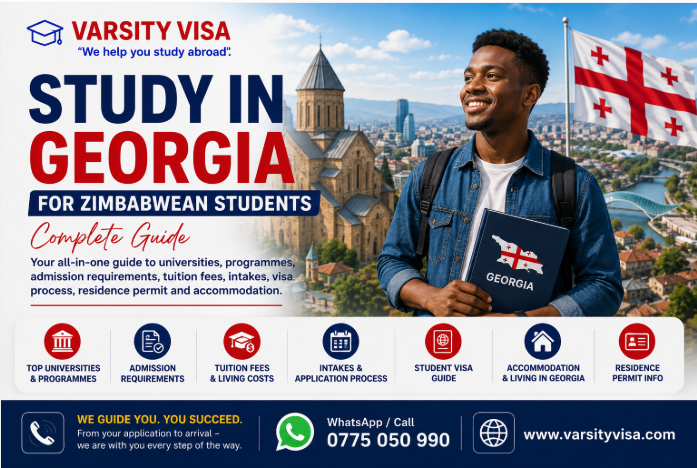
Georgia has become an increasingly visible study destination for international students looking for English-taught university programmes and alternatives to traditional destinations such as the United Kingdom, Canada and Australia.
For Zimbabwean applicants, Georgia may offer programmes in areas such as Medicine, Dentistry, Business, Computer Science, Information Technology, Engineering and other disciplines.
However, students should understand that studying in Georgia involves more than simply receiving a university offer letter.
The process can involve:
- Selecting an authorised university and appropriate programme
- Meeting the university's admission requirements
- Recognition of foreign education documents
- Receiving the required admission documentation
- Preparing the D3 student visa application
- Demonstrating adequate financial preparation
- Travelling to Georgia
- Applying for the appropriate residence permit after arrival where required
Why Consider Studying in Georgia?
Georgia's appeal to international students comes from a combination of programme availability, English-medium options and tuition levels that can be lower than many traditional Western destinations.
English-Taught Programmes
International students can find programmes taught in English at selected Georgian universities.
Multiple Programme Areas
Options include Medicine, Dentistry, Computer Science, IT, Business, Engineering and other disciplines.
International Student Market
Several Georgian universities actively recruit international students and operate international offices.
Alternative Study Destination
Georgia can provide another route for students who want to compare cost, admission requirements and programme availability outside the most expensive study destinations.
Universities in Georgia for International Students
Georgia has both public and private higher education institutions offering programmes to international students.
Examples appearing on Georgia's official international education portal include institutions such as:
- Tbilisi State University
- Georgian Technical University
- Ilia State University
- University of Georgia
- International Black Sea University
- Georgian American University
- Caucasus International University
- Alte University
- Other authorised Georgian higher education institutions
Popular Courses to Study in Georgia
Medicine
Georgia is particularly visible internationally for English-medium medical education. Medical education in Georgia is generally structured as a six-year one-step programme.
Dentistry
Selected institutions offer Dentistry to international students in English. Fees and admission criteria vary substantially by institution.
Computer Science & IT
English-language Computer Science and Information Technology programmes are available at selected institutions.
Business
Students may find Business Administration, Management, Finance and related commercial programmes.
Engineering
Engineering and technical fields may be available through universities with specialist faculties and laboratories.
Social Sciences
Some institutions offer programmes in international relations, politics, social sciences and related fields.
The correct programme should be chosen based on:
- Academic background
- Relevant O-Level and A-Level subjects
- Career goals
- Budget
- Professional recognition requirements
- Language of instruction
Admission Requirements for Zimbabwean Students
Admission requirements vary by institution and programme.
A university may ask for:
- Valid passport
- High school certificate
- O-Level and/or A-Level results
- Diploma or degree documents for postgraduate applicants
- Academic transcripts
- Passport photograph
- Completed university application
- English-language evidence where required
- Interview or entrance assessment where applicable
- Translated or notarised documentation where required
Can Zimbabwean Students Study in Georgia with O-Level?
This depends on the institution, programme and Georgian admission rules applicable to the student's academic profile.
Students should not assume that O-Level alone creates direct Bachelor's entry across every programme.
Possible outcomes may include:
- Direct eligibility where the institution and authorities accept the qualification
- A preparatory or foundation route
- A request for additional education evidence
- Ineligibility for a particular programme
Studying in Georgia After A-Level
Zimbabwean students holding recognised A-Level qualifications may have a stronger direct-entry profile for Bachelor's-level programmes, subject to the programme's subject and grade requirements.
Universities may pay particular attention to:
- Mathematics for Computer Science, IT and technical programmes
- Physics and Mathematics for Engineering
- Biology and Chemistry for medical or health-related programmes
- English proficiency
- Overall academic performance
Do You Need IELTS to Study in Georgia?
English requirements differ between universities.
Depending on the institution, a student may be asked for:
- IELTS
- TOEFL
- Another recognised English test
- An internal university English assessment
- An interview
- Evidence of previous English-medium education where accepted
Recognition of Foreign Education Documents
This is one of the most important parts of the Georgia admission process for international applicants.
Georgia's National Center for Educational Quality Enhancement handles the recognition of education obtained abroad.
The recognition process verifies:
- The authenticity of the foreign education document
- The status of the issuing institution
- The compatibility of the qualification or learning outcomes with Georgian qualifications
Georgia University Intakes
Intakes vary by university and programme.
Georgia's official international education listings show that many programmes operate with:
- Spring intake
- Autumn intake
Some institutions or programmes may follow different calendars.
How Much Does It Cost to Study in Georgia?
Tuition varies significantly by programme and university.
Current official programme listings illustrate the variation:
| Programme Type | Illustrative Fee Level | Important Note |
|---|---|---|
| Computer Science / IT | Some programmes around USD 3,500–4,000 per year | Fees vary by university and programme. |
| Business / Social Sciences | Varies by institution | Always use the current official university quotation. |
| Medicine | Some English programmes around USD 6,000 per year | Other universities may charge more. |
| Dentistry | Some programmes around USD 5,000 per year | Programme-specific quotation required. |
Living Costs in Georgia
Your total study budget should include more than tuition.
Students need to plan for:
- Accommodation
- Food
- Transport
- Mobile data and internet
- Medical insurance
- Residence documentation
- Study materials
- Personal expenses
- Winter clothing
- Emergency funds
How to Apply to Study in Georgia
Georgia Study Application Journey
- Choose the correct programme.
Compare programme content, university status, tuition, location and career implications. - Submit the university application.
Provide passport and academic documentation required by the institution. - Complete academic assessment.
The institution determines whether you meet programme entry requirements. - Complete foreign education recognition where required.
Your foreign qualifications may need recognition through Georgia's education quality authorities. - Receive admission documentation.
The university issues the applicable admission or enrolment documentation. - Make required university payments.
Follow the university's official invoice and payment instructions. - Prepare the D3 visa application.
Gather the immigration, financial, insurance, accommodation and admission documents required for long-term study. - Travel after visa approval.
Do not purchase a non-refundable flight simply because you have an offer letter. - Complete residence formalities after arrival.
Eligible students may need to apply for a study residence permit before their lawful stay expires.
Georgia Student Visa for Zimbabwean Students
Foreign nationals travelling to Georgia for long-term study at an authorised educational institution use the D3 immigration visa.
Georgia's official international education portal states that the D3 visa is issued for long-term educational purposes and is generally valid for 90 days with multiple entries.
The Georgian Ministry of Foreign Affairs and the relevant Georgian diplomatic or consular authority assess visa applications.
Common Georgia Student Visa Documents
The exact checklist should always be confirmed for the applicant's consular route, but students may need documents such as:
- Valid passport
- Completed visa application
- University admission or enrolment documentation
- Academic documents
- Recognition or education-related documents where applicable
- Proof of tuition payment where required
- Financial evidence
- Sponsor documentation where applicable
- Accommodation evidence
- Medical or travel insurance
- Passport photographs
- Flight or travel information where required
- Additional documentation requested by the visa authority
Georgia Student Residence Permit
The D3 visa facilitates entry for long-term study, but students should also understand the residence stage.
Georgia's Public Service Development Agency handles residence permits.
A foreign student may need documentation including:
- Passport
- Evidence of lawful stay
- University confirmation
- Financial evidence
- Photograph
- Application documents
- Applicable service fee
Student Accommodation in Georgia
Accommodation arrangements vary by university and city.
Students may use:
- University-arranged accommodation
- Private student residences
- Shared apartments
- Private rooms
- Independent apartments
Before paying for accommodation, check:
- Distance from campus
- Public transport
- Deposit
- Monthly rent
- Utilities
- Heating
- Internet
- Contract terms
- Security
Can International Students Work While Studying in Georgia?
Students should not build their Georgia study budget on assumptions about part-time work.
Employment rules, employer requirements and immigration conditions should be checked independently before accepting employment.
We will cover this separately in our detailed article on Working While Studying in Georgia.
Studying Medicine in Georgia
Medicine is one of Georgia's most visible international education sectors.
Georgia's education quality authority states that higher medical education is structured as a six-year programme, after which the graduate receives the qualification of certified medical doctor.
Students considering Medicine should investigate:
- Programme accreditation
- University status
- Clinical training arrangements
- Teaching hospital access
- Language used during clinical years
- Recognition in the country where they intend to practise
- Professional licensing examinations
Will a Georgian Degree Be Recognised?
This question must be answered according to:
- The university
- The specific programme
- Accreditation status
- The profession
- The country where the graduate wants to work
- The professional regulator
For professions such as:
- Medicine
- Dentistry
- Nursing
- Pharmacy
- Engineering
- Law
the student should investigate professional registration requirements before enrolling.
Common Mistakes Zimbabwean Students Should Avoid
- Choosing Georgia based only on cheap tuition
- Paying before confirming the university and programme
- Assuming every programme accepts O-Level
- Ignoring education recognition procedures
- Believing an offer letter guarantees the visa
- Using an outdated visa checklist
- Ignoring accommodation deposits and living expenses
- Assuming part-time work will fund tuition
- Choosing Medicine without checking professional recognition
- Booking flights before immigration approval
- Submitting altered or false documents
- Failing to budget for residence permit formalities
- Ignoring winter living costs
- Choosing a university purely from social-media advertising
Frequently Asked Questions
Can Zimbabweans study in Georgia?
Yes. Zimbabwean students can apply to authorised Georgian higher education institutions offering programmes to international students, subject to admission and immigration requirements.
What visa do students need for Georgia?
Foreign nationals travelling for long-term study at an authorised Georgian educational institution generally use the D3 immigration visa.
How long is the Georgia D3 visa valid?
Georgia's official international education portal states that the D3 study visa is generally issued for 90 days with multiple entries.
Can I study Medicine in Georgia?
Yes. Selected Georgian universities offer English-medium medical programmes to international students. Medical education is generally structured as a six-year programme.
Do I need IELTS?
Not every institution uses the same English requirement. Some universities may accept alternative evidence or conduct their own English assessment. Always confirm the requirement for the specific programme.
Do my Zimbabwean qualifications need recognition?
Foreign education may need to undergo recognition through Georgia's National Center for Educational Quality Enhancement as part of the applicable admission process.
Can I work while studying in Georgia?
Students should confirm the current employment and immigration rules before working and should not rely on employment to fund tuition or essential living expenses.
Is a Georgian medical degree automatically recognised in Zimbabwe?
No professional qualification should be assumed to provide automatic registration. Students should confirm the requirements of the relevant Zimbabwean professional regulator before enrolling.
Does university admission guarantee a Georgia student visa?
No. University admission and immigration approval are separate processes.
Can Varsity Visa guarantee a Georgian visa?
No. Varsity Visa can assist with programme selection, university admission and visa-document preparation, but the final immigration decision belongs to the Georgian authorities.
Final Thoughts
Georgia can be a serious study option for Zimbabwean students, particularly those comparing English-taught programmes and tuition levels across different international destinations.
But the strongest applications start with the correct sequence:
- Choose the right programme
- Verify the university
- Check admission eligibility
- Complete education recognition correctly
- Understand the total budget
- Prepare the D3 visa carefully
- Arrange realistic accommodation
- Complete residence formalities on time
- Verify professional recognition before enrolling in regulated programmes
Official Georgia Study Resources
- Education in Georgia – Official International Study Portal
- Georgia International Student Application Procedures
- Georgia Study Permits and Visas
- Ministry of Foreign Affairs of Georgia – Visa Information
- National Center for Educational Quality Enhancement – Recognition of Foreign Education
- Georgia Public Service Development Agency – Residence Permits
Get a Free Georgia Study Assessment
Varsity Visa can assess your qualifications, recommend suitable Georgian programmes and help you understand admission requirements, tuition, document recognition, the D3 visa process and the realistic budget needed before travelling.