
Georgia University Admission Requirements for Zimbabwean Students
A practical guide to the academic qualifications, O-Level and A-Level requirements, documents, English-language conditions, foreign education recognition and application process Zimbabwean students should understand before applying to a Georgian university.
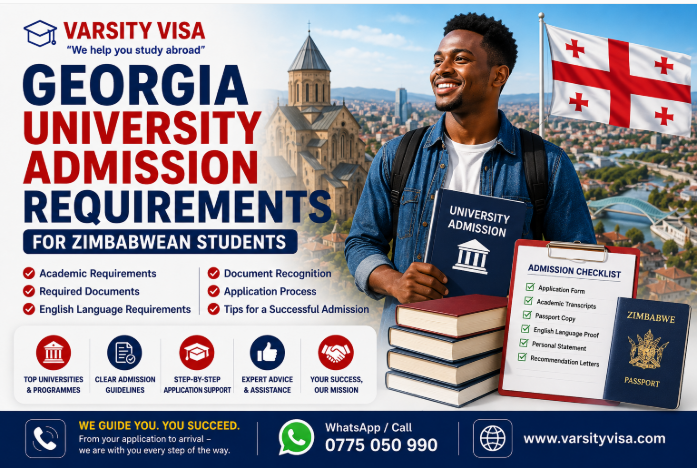
Applying to study in Georgia involves more than choosing a university and sending a passport copy.
A student must first satisfy the academic requirements of the chosen programme, provide the required educational documents and complete any recognition procedures that apply to foreign qualifications.
For Zimbabwean students, universities may assess qualifications such as:
- ZIMSEC O-Level
- Cambridge O-Level or IGCSE
- ZIMSEC A-Level
- Cambridge A-Level
- Diplomas
- Bachelor's degrees
- Postgraduate qualifications
For the complete study process, read: Study in Georgia for Zimbabwean Students: Complete Guide .
General Admission Requirements for Georgian Universities
Georgia's higher education system includes Bachelor's, Master's and doctoral levels.
Foreign applicants may be admitted through procedures applicable to international students rather than following exactly the same route as domestic applicants.
At a practical university level, students may need:
- A completed secondary-school qualification for undergraduate study
- A relevant Bachelor's degree for Master's study
- A relevant Master's qualification for many doctoral programmes
- Academic transcripts
- Valid passport
- Programme-specific subjects
- English-language evidence where required
- Interview or assessment where applicable
- Foreign education recognition where applicable
Can Zimbabwean Students Study in Georgia with O-Level?
This question should be assessed carefully.
O-Level is an important academic qualification, but students should not assume that O-Level alone guarantees direct entry into every Georgian Bachelor's degree.
A university may determine that the applicant:
- Qualifies for direct entry
- Needs additional school-level education
- Needs a foundation or preparatory route
- Does not meet a particular programme's subject requirements
Medicine, Dentistry and Engineering should be assessed particularly carefully because science and Mathematics requirements may apply.
Applying to Georgia with A-Levels
Zimbabwean students with A-Level qualifications may present a stronger academic profile for direct Bachelor's-level entry.
Universities may examine:
- A-Level subjects
- A-Level grades
- O-Level subjects
- Mathematics performance
- Science subjects
- English proficiency
- The connection between previous study and intended programme
Bachelor's Degree Admission
A student applying for Bachelor's-level study generally needs evidence of completed secondary education or an equivalent recognised qualification.
Typical documents may include:
- Secondary-school certificate
- O-Level results
- A-Level results where applicable
- Academic transcript or statement of results
- Passport
- Passport photograph
- English evidence where required
Master's Degree Admission Requirements
Students applying for postgraduate study normally need a relevant Bachelor's-level qualification.
Depending on the programme, universities may request:
- Bachelor's degree certificate
- Full academic transcript
- Curriculum vitae
- Motivation letter
- Recommendation letters
- English-language evidence
- Interview
- Portfolio for selected programmes
- Research or professional experience
Medicine Admission Requirements
Medicine is one of the programmes for which students should avoid generic admission advice.
Universities may examine subjects such as:
- Biology
- Chemistry
- Physics
- Mathematics
- English
The applicant may also face:
- University interview
- English assessment
- Academic evaluation
- Science-subject verification
Dentistry Admission Requirements
Dentistry can have similar science-related admission considerations to Medicine.
Applicants should expect the university to assess:
- Secondary education
- Biology
- Chemistry
- English ability
- Overall academic performance
Engineering Admission Requirements
Engineering applicants should expect Mathematics and Physics to be important for many programmes.
Possible requirements include:
- Mathematics
- Physics
- English
- Relevant technical subjects
- Academic interview or assessment where required
Computer Science and IT Admission Requirements
Computer Science and Information Technology are increasingly popular among international applicants.
Universities may consider:
- Mathematics
- Computer Science or ICT where studied
- Physics or technical subjects
- English proficiency
- Overall secondary-school performance
Business and Management Admission Requirements
Business programmes may have broader subject flexibility than Medicine or Engineering.
Useful subjects include:
- Mathematics
- Business Studies
- Accounting
- Economics
- English
Possible programme areas include:
- Business Administration
- Finance
- Management
- Marketing
- International Business
English-Language Requirements
Georgia has English-taught programmes for international students, but English requirements vary by university and programme.
Depending on the institution, students may be asked for:
- IELTS
- TOEFL
- Another recognised English test
- Evidence of English-medium education
- Internal English-language test
- University interview
Documents Commonly Required for Admission
A typical international university application may require:
Identity Documents
- Passport
- Passport photograph
- Application form
Academic Documents
- O-Level certificate
- A-Level certificate
- School transcript
- Diploma where applicable
- Degree certificate
- University transcript
Language Documents
- English test result
- Medium of Instruction evidence where accepted
- Internal assessment result
Programme-Specific Documents
- Portfolio
- CV
- Motivation letter
- Recommendations
- Research proposal
Recognition of Zimbabwean Educational Qualifications
Georgia's National Center for Educational Quality Enhancement handles the recognition of education obtained abroad.
The recognition process verifies:
- The authenticity of the foreign educational document
- The status of the issuing educational institution
- The correspondence of the qualification with Georgia's education system
Admission and Recognition Are Different
Translations and Notarisation
Foreign documents may need translation into Georgian or another accepted format depending on the stage of the application.
Students may encounter requirements relating to:
- Certified translations
- Notarised copies
- Document authentication
- Legalisation where applicable
- Clear scanned copies
University Interviews and Entrance Assessments
Some Georgian universities may assess international applicants through an online interview or entrance assessment.
The interview may test:
- English communication
- Academic readiness
- Motivation
- Programme understanding
- Basic subject knowledge
For medical applicants
A university may ask questions related to Biology, Chemistry or general academic readiness.
For Business applicants
The interview may focus more heavily on English ability, motivation and general academic preparation.
How to Apply to a Georgian University
Georgia's official international study portal recommends that students first research programmes and universities, choose a programme and then contact the international office of the chosen institution.
- Choose your programme.
Compare course content, tuition, duration and career implications. - Check your eligibility.
Confirm whether your O-Level, A-Level, diploma or degree meets the programme requirements. - Prepare your academic documents.
Collect certificates, transcripts and passport documentation. - Submit the university application.
Apply through the university's official admissions route. - Complete an interview or assessment where required.
Some programmes use an academic or English-language evaluation. - Complete foreign education recognition.
Follow the university and Georgian authority procedures applicable to your qualification. - Receive final admission documentation.
Make sure all university and recognition conditions have been satisfied. - Pay the required university amount.
Use only official university payment instructions. - Proceed to the D3 visa stage.
Admission does not replace the immigration application.
Offer Letter vs Final Admission
Students frequently treat these terms as though they mean the same thing. They may not.
| Stage | What It Means |
|---|---|
| Application received | The university has received the student's documents. |
| Conditional offer | The university may be willing to admit the student if outstanding conditions are met. |
| Recognition stage | The student's foreign education documents undergo applicable recognition procedures. |
| Final admission | The student has satisfied the university's final academic conditions. |
| Visa approval | Georgian immigration authorities independently approve travel for study. |
University Admission Does Not Guarantee the Student Visa
After admission, a Zimbabwean student may still need to apply for the appropriate Georgia D3 student visa.
The immigration authorities assess matters such as:
- Purpose of travel
- Admission evidence
- Financial resources
- Accommodation
- Insurance
- Passport and identity documents
- Other relevant immigration requirements
The visa answers an immigration question. They are not the same decision.
Read our full guide: Georgia Student Visa Requirements for Zimbabwean Students .
Common Admission Mistakes
- Applying without checking programme-specific subjects
- Assuming O-Level guarantees direct Bachelor's admission
- Assuming A-Level guarantees every programme
- Submitting incomplete academic documents
- Ignoring foreign education recognition
- Using inconsistent names across documents
- Assuming every university accepts the same English evidence
- Claiming Georgia is universally IELTS-free
- Choosing Medicine without checking Biology and Chemistry requirements
- Choosing Engineering without checking Mathematics and Physics
- Paying tuition before verifying the institution and programme
- Using altered or false academic documents
- Confusing a conditional offer with final admission
- Assuming admission guarantees the visa
Frequently Asked Questions
Can Zimbabwean students apply to Georgian universities?
Yes. Zimbabwean students can apply to authorised Georgian higher education institutions offering programmes to international students, subject to academic and programme requirements.
Can I study in Georgia with O-Level?
Possibly, depending on the qualification, university and programme. O-Level should not be treated as automatic direct entry into every Bachelor's degree.
Can I apply with A-Levels?
Yes. A-Level applicants may qualify for Bachelor's-level study where they meet the programme's academic and subject requirements.
Do I need IELTS?
Not necessarily. English-language requirements vary. Some universities may accept other evidence or conduct an internal English assessment.
Do Zimbabwean certificates need recognition?
Foreign educational qualifications may need recognition through Georgia's National Center for Educational Quality Enhancement as part of the applicable admission process.
What subjects do I need for Medicine?
Requirements vary by university, but science subjects such as Biology and Chemistry are commonly important and additional assessment may apply.
What subjects do I need for Engineering?
Mathematics and Physics are commonly relevant to Engineering admission, although the exact requirements depend on the specific programme.
Does an offer letter mean I am fully admitted?
Not always. An offer may be conditional on document recognition, academic verification, payment or other requirements.
Does admission guarantee the Georgia student visa?
No. University admission and immigration approval are separate processes.
Can Varsity Visa guarantee university admission?
No. Varsity Visa can assess qualifications, recommend suitable programmes and assist with applications, but admission decisions belong to the university and relevant Georgian authorities.
Final Thoughts
The most important mistake to avoid is treating Georgia as though every student qualifies for every programme.
A proper admission assessment should consider:
- Highest qualification
- Academic subjects
- Grades
- Programme prerequisites
- English ability
- Foreign education recognition
- Tuition budget
- Career goals
- Professional recognition where applicable
Official Georgia Admission Resources
Get a Free Georgia Admission Assessment
Varsity Visa can assess your O-Level, A-Level, diploma or degree qualifications and help identify Georgian programmes that match your academic profile, career direction and study budget.