
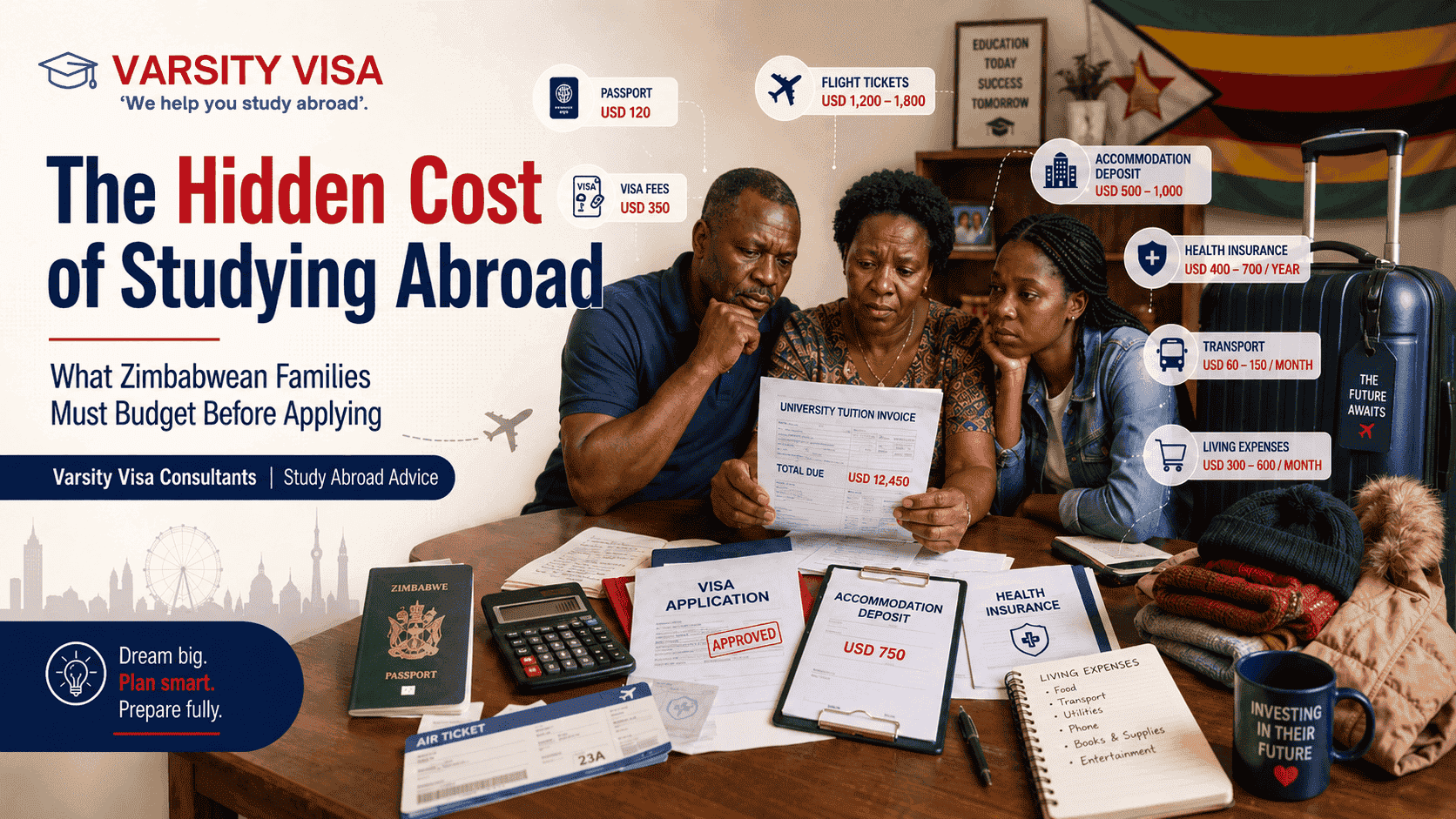
The Hidden Cost of Studying Abroad That Nobody Tells Zimbabwean Families
Every year, Zimbabwean families celebrate an overseas university offer letter without fully understanding the financial commitment behind it.
A child receives an offer letter. The university sends a tuition invoice. Excitement fills the home. Parents begin calculating how to make it work.
Then reality arrives.
Not because the university misled them, but because they planned for the advertised cost rather than the real cost.
Before you spend thousands of dollars and commit several years of your life to an overseas degree, there are expenses, risks, and realities that rarely appear in university brochures. Understanding them could save your family significant financial stress later.
Quick Answer: The real cost of studying abroad is usually higher than the advertised tuition fee. Zimbabwean families must budget for accommodation, visa fees, health insurance, flights, settling-in costs, daily living expenses, emergency funds, exchange-rate changes, academic failure costs, return costs, and post-graduation realities.
Important: A study abroad decision should not be based on tuition alone. The tuition fee gets you admitted. The hidden costs determine whether the journey remains sustainable.
What This Guide Covers
1. Why Tuition Is Not the Real Cost 2. Five Costs That Surprise Zimbabwean Families 3. The Settling-In Period 4. Currency and Transfer Gaps 5. Academic Failure Costs 6. Emergency Funds 7. Return and Graduation Costs 8. The Post-Graduation Reality 9. Opportunity Cost 10. Sample First-Year Budget 11. Five Questions Before Applying 12. How Varsity Visa Can Help 13. Frequently Asked Questions1. Why the Advertised Tuition Fee Is Almost Never the Real Cost
The tuition fee is usually the first number families see.
It is also the most misleading.
Universities naturally highlight the most visible cost: tuition. A programme may advertise tuition of $7,000 per year, but tuition is only one component of the total financial commitment.
What often gets overlooked are:
- Registration and administrative fees
- Student union fees
- Health insurance requirements
- Visa application costs
- Accommodation deposits
- Flight expenses
- IELTS preparation costs
- Residence permit fees
- Winter clothing and settling-in expenses
- Daily living costs
In many cases we have reviewed, the realistic first-year cost can be 30–50% higher than the amount families originally expected.
If you are specifically considering Poland, do not budget from tuition alone. Read our full guide on how much it really costs to study in Poland as a Zimbabwean student before committing to application fees or tuition deposits.
The hard truth: The tuition fee gets you admitted. The hidden costs determine whether the student can survive, settle, and complete the journey.
2. Five Costs That Consistently Surprise Zimbabwean Families
Most families do not fail to plan because they are careless.
They fail to plan because the real costs are scattered across different stages of the process. Some costs appear before departure, some appear after arrival, and some appear only when things go wrong.
This is why families should not rush from “offer letter” to payment. They must first understand the full route from admission to visa preparation. For Poland applicants, our guide on how to apply to Polish universities without wasting money explains why the application stage must be handled strategically.
3. The Settling-In Period
Most budgets focus on monthly expenses.
Very few budgets properly account for the first month.
The first four to eight weeks abroad are usually one of the most expensive periods of a student’s journey.
Students are:
- Paying accommodation deposits
- Purchasing bedding and household items
- Learning transport systems
- Buying winter clothing
- Registering with local authorities
- Opening bank accounts
- Adjusting to a completely new environment
During this period, spending is often unpredictable and significantly higher than normal monthly living costs.
Planning mistake: Many students experience financial pressure before classes have even begun because the family only budgeted for tuition and rent.
4. The Currency and Transfer Gap
Studying abroad from Zimbabwe comes with challenges many families in other countries never have to consider.
Exchange rates move. Transfer fees apply. Banking restrictions change. Payment timelines can shift.
Money that seemed sufficient when planning may no longer be sufficient six months later.
A family that prepares a budget in January may discover in August that costs have increased materially.
This is not always poor planning.
It is the reality of funding international education from Zimbabwe.
The solution is not perfection. The solution is building a realistic buffer into the budget before committing.
5. Academic Failure Costs
No family expects their child to fail a course.
Unfortunately, adjustment challenges are common.
A student who excelled at A-Level may still struggle with:
- Different teaching methods
- Language barriers
- Independent learning expectations
- Cultural adaptation
- Part-time work pressure
- Homesickness and loneliness
Academic readiness also matters. A student who is not properly qualified may waste money applying to the wrong pathway. For Poland applicants, read Can I Study in Poland with O-Levels Only? before paying application fees.
In many countries, failed modules come with resit fees. In some cases, students may need to repeat a semester or even an academic year.
The financial impact can be significant.
An additional semester means additional tuition, accommodation, food, transport, insurance, and living costs.
Reality check: Very few families include academic failure, resits, or delayed graduation in their original calculations.
6. The Emergency Fund That Does Not Exist
Life happens.
Laptops break. Medical emergencies occur. Accommodation arrangements collapse. Family emergencies may require urgent travel.
The students who navigate these situations successfully usually have an emergency reserve available.
The students who struggle often have no financial cushion at all.
Varsity Visa planning advice: As a rule of thumb, families should aim to maintain an emergency reserve equivalent to at least three to four months of living expenses.
The goal is not to spend it.
The goal is to never need it.
7. The Return Cost
Most families focus entirely on departure.
Very few think carefully about what happens at graduation.
Yet graduation introduces a new set of costs.
Students may need funds for:
- Flights home
- Additional accommodation
- Residence permit extensions
- Job-search periods
- Postgraduate applications
- Document legalization or certification
- Professional registration where applicable
Visa preparation should start before the student pays major fees. Families considering Poland should also review our guide on Poland student visa requirements for Zimbabwean students .
The financial journey does not necessarily end when the degree ends.
In many cases, it enters a new phase.
8. The Post-Graduation Reality: What Happens After the Degree?
One of the most important questions families rarely ask is what happens after graduation.
Many parents focus on getting the student admitted, securing the visa, paying tuition, and sending the child abroad. Those are important steps, but they are not the full journey.
The bigger question is:
What is the plan after the degree is completed?
Some countries offer clear post-study work opportunities. Others have limited options. In some destinations, international students may find it difficult to remain after graduation unless they secure employment, meet strict immigration requirements, or qualify for another visa pathway.
This matters because studying abroad is not just an academic decision. It is a financial and life decision.
If a family spends $15,000, $20,000, or more on an overseas qualification, they must ask whether the destination gives the student a realistic pathway after graduation.
That pathway may include:
- Returning to Zimbabwe with a stronger qualification
- Applying for postgraduate studies
- Looking for work in the study destination
- Moving to another country with better opportunities
- Starting a business or professional career back home
- Using the qualification to access regional or international opportunities
None of these options is automatically wrong.
The mistake is not returning home.
The mistake is spending thousands of dollars without understanding that returning home may be the most likely outcome.
Important distinction: Studying abroad and settling abroad are not the same thing. A country may offer education access without offering an easy long-term work pathway.
For some students, returning to Zimbabwe after studying abroad can still be a good investment if the qualification leads to better employment, professional registration, business opportunities, or postgraduate options.
For others, it may not make financial sense.
This is why families should ask before applying:
Are we paying for an international education only, or are we also expecting an international work pathway?
Those are not always the same thing.
A country may be affordable for tuition but weak for post-graduation opportunities. Another country may be more expensive but provide a clearer route to work experience after study. A third country may allow study but offer limited part-time work, making the financial pressure much heavier during the course.
Before choosing a destination, families must understand:
- Can international students work while studying?
- Are there realistic part-time job opportunities?
- Is there a post-study work visa or graduate route?
- How difficult is it to secure employment after graduation?
- Is the qualification useful back in Zimbabwe?
- Does the course lead to a profession with demand locally or internationally?
- What happens if the student must return home immediately after graduation?
These questions are uncomfortable, but they are necessary.
A study abroad plan should not end at the airport.
It should not even end at graduation.
A serious plan must answer what happens next.
9. The Cost Nobody Can Calculate Precisely: Opportunity Cost
This is the hardest cost to measure.
While one student spends four years studying abroad, another may spend those same four years:
- Building a business
- Gaining work experience
- Developing professional networks
- Investing capital elsewhere
- Starting a local career path
This does not mean studying abroad is a bad investment.
Far from it.
Many international qualifications completely transform a student’s future.
However, every major decision should be compared against the alternatives.
The question is not simply: “Can we afford this degree?”
The better question is: “Is this the best use of our time, money, and opportunities?”
That calculation looks different for every family.
10. What a More Realistic First-Year Budget Looks Like
For illustration only, consider a Zimbabwean student studying a high-cost programme such as medicine in Poland.
Course choice affects cost, admission strength, career direction, and visa logic. Before choosing a programme, read our guide on the best courses to study in Poland in 2026 .
| Cost Item | Estimated First-Year Cost | Why It Matters |
|---|---|---|
| Tuition | $7,000–$9,000 | Main academic cost, but not the total cost. |
| Accommodation | $2,400–$4,800 | Rent, deposits, utilities, and housing arrangements can vary widely. |
| Living Expenses | $3,600–$5,000 | Food, transport, phone, internet, and basic personal expenses. |
| Health Insurance | $400–$700 | Often required for visa, residence permit, or university compliance. |
| Flights | $1,200–$2,000 | Flight prices change depending on timing and route. |
| Settling-In Costs | $800–$1,500 | Bedding, winter clothing, transport setup, registrations, and basic items. |
| Emergency Reserve | $2,000–$3,000 | Recommended buffer for unexpected problems. |
| Realistic First-Year Budget | $17,400–$26,000 | The real figure may be much higher than advertised tuition. |
The university may advertise tuition from $7,000.
Families often budget around $12,000.
The realistic figure is often much closer to $20,000.
That gap is where financial pressure begins.
11. Five Questions Every Family Should Answer Before Applying
Before committing to any international education pathway, ask:
- What is the realistic total cost of the entire qualification?
- What happens financially if the student repeats a semester or year?
- Do we have an emergency reserve?
- What is the graduate’s plan during the first 12 months after completion?
- If we did not spend this money on overseas education, what would be the alternative use of these resources?
If these questions cannot be answered confidently, the family may not yet be ready to apply.
They may still need to plan.
12. Why Varsity Visa Focuses on Planning Before Applications
Varsity Visa Consultants helps Zimbabwean students and parents make informed education decisions before committing thousands of dollars to applications, visas, deposits, and tuition.
Whether you are considering Poland, Malaysia, Georgia, Dubai, the UK, or another destination, our role is not simply to sell you a country.
Our role is to help you determine whether the opportunity makes sense for your goals, finances, academic background, visa readiness, post-graduation options, and future plans.
The goal is not simply to study abroad. The goal is to make a decision that still looks wise five years from now.
Need Help Evaluating Your Study Abroad Budget?
Before you pay application fees, deposits, or tuition, speak to Varsity Visa. A proper budget review can save your family from committing to a pathway that looks affordable on paper but becomes stressful in practice.
Send BUDGET REVIEW on WhatsApp.
WhatsApp +263 775 050 99013. Frequently Asked Questions
Is tuition the full cost of studying abroad?
No. Tuition is only one part of the cost. Families must also budget for accommodation, flights, visa fees, health insurance, settling-in expenses, living costs, and emergency reserves.
How much extra should Zimbabwean families budget beyond tuition?
In many cases, the realistic first-year cost can be 30–50% higher than the amount families first expected. The exact figure depends on the country, university, programme, accommodation, and lifestyle.
Why is the first month abroad expensive?
The first month often includes accommodation deposits, bedding, household items, transport setup, winter clothing, registration costs, and unexpected settling-in expenses.
Should every student have an emergency fund?
Yes. Families should aim to maintain an emergency reserve equivalent to at least three to four months of living expenses where possible.
Should families consider post-graduation work opportunities before choosing a country?
Yes. Families should understand whether the country offers realistic part-time work, graduate work options, employment opportunities, or a clear return-home plan before committing money.
Is returning to Zimbabwe after studying abroad a failure?
No. Returning home can still be a good outcome if the qualification improves employment, business, professional registration, or postgraduate opportunities. The mistake is spending money without understanding that returning may be the most likely outcome.
Can Varsity Visa help families calculate the real cost?
Yes. Varsity Visa helps Zimbabwean families evaluate study destinations, tuition, accommodation, living expenses, visa costs, sponsor readiness, post-graduation options, and overall affordability before applying.
What should families do before paying tuition or deposits?
Families should confirm the full first-year cost, refund policy, visa readiness, sponsor documents, accommodation plan, emergency reserve, and post-graduation pathway before paying major fees.
Make a Study Abroad Decision That Still Looks Wise Five Years From Now
Varsity Visa can help you assess your academic background, destination options, full budget, sponsor documents, visa readiness, post-graduation pathway, and long-term career plan.
Send BUDGET REVIEW on WhatsApp.
WhatsApp +263 775 050 990